
Blog

Digital Marketing in Nepal featuring SEO, website development, social media marketing, content marketing, local SEO, paid advertising, video marketing, analytics, and digital business growth against a Kathmandu and Himalayan backdrop.
Blog

Digital Marketing in Nepal: SEO, Website Development & Complete Guide for Businesses

Digital Marketing in Nepal: SEO & Website Development Complete Guide for Businesses Digital marketing in Nepal has evolved rapidly from simple social media promotion into a complete digital growth system involving websites, search engine optimisation (SEO), local search, social media, content marketing, online advertising, analytics, conversion optimisation, and AI-powered search.  For a Nepali business today, having a Facebook page or occasionally posting on Instagram is no longer the same thing as having a strong digital presence. Customers may discover a business through Google Search, Google Maps, Facebook, Instagram, TikTok, YouTube, online reviews, a business website or increasingly through AI-powered search experiences. They may compare several companies before contacting one through a website form, phone call, Messenger or WhatsApp. This makes digital marketing more interconnected than ever. A business needs to be discoverable, credible, useful and easy to contact across the digital journey. According to DataReportal’s Digital 2026: Nepal report, Nepal had an estimated 16.6 million internet users at the end of 2025, representing 56% of the population. The report also recorded 14.8 million social-media user identities in October 2025, equivalent to 50% of the population. DataReportal cautions that social-media user identities should not automatically be interpreted as unique individuals. These numbers demonstrate why digital channels have become important for businesses targeting customers in Nepal as well as companies selling Nepali products and services internationally.  But digital marketing is not simply about being present online. The real objective is to connect visibility with business outcomes. A successful digital marketing system should help a business: Get discovered → Build trust → Educate customers → Generate inquiries → Convert customers → Measure results → Improve continuously. This guide explains how digital marketing in Nepal works, what services businesses need, how SEO and website development fit together, how AI search is changing digital visibility, and how Nepali businesses can build a practical long-term strategy. What Is Digital Marketing in Nepal? Digital marketing in Nepal is the use of digital platforms, technologies and online channels to promote a business, product, service, organisation, or personal brand to relevant audiences. It can include: Search engine optimisation Website design and development Local SEO Google Business Profile Social media marketing Content marketing Google Ads Meta advertising Video marketing Email marketing Online reputation management Conversion optimisation Analytics and reporting AI-search visibility The exact combination depends on the business. A trekking company, restaurant, education consultancy, software company and e-commerce store should not necessarily use the same digital marketing strategy. For example, a trekking company may need strong destination SEO, travel content, Google Business Profile optimisation, YouTube videos and international search visibility. A Kathmandu-based B2B company may need a professional website, LinkedIn, SEO, case studies and lead-generation campaigns. An e-commerce business may require product SEO, paid advertising, conversion optimisation, and remarketing. Therefore, digital marketing should begin with the business model and customer journey—not with a list of platforms. Why Digital Marketing Matters for Businesses in Nepal Nepal’s digital environment has become large enough that businesses can no longer treat online marketing as optional. DataReportal’s Digital 2026 Nepal report estimated 16.6 million internet users at the end of 2025 and 14.8 million social-media user identities in October 2025. It also reported that 89.3% of Nepal’s internet users used at least one social-media platform in October 2025. This creates opportunities across several stages of the customer journey. Customers can discover businesses online A customer might search: digital marketing agency in Nepal SEO company in Kathmandu website development company Nepal trekking agency in Kathmandu hotel in Pokhara restaurant in Thamel education consultancy in Nepal These searches can represent highly relevant commercial intent. Customers can research before buying Before contacting a business, customers may: Read the website Compare services Check reviews Look at social media Watch videos Search for the brand Read FAQs Compare prices or packages Look for evidence of expertise A strong online presence therefore needs more than advertising. Customers can contact businesses immediately Digital channels can connect discovery directly to action. A customer can move from: Google Search → Website → Service Page → WhatsApp → Inquiry or: Instagram → Profile → Website → Booking → Purchase The shorter and clearer this journey becomes, the easier it is for a potential customer to take action. The Main Components of Digital Marketing in Nepal A complete strategy can contain multiple interconnected components. 1. Search Engine Optimisation in Nepal SEO is the process of improving a website so search engines can understand its content and users can discover relevant pages through organic search. Google describes SEO as helping search engines understand content and helping users find websites through search. Its current Search Essentials emphasise technical eligibility, spam compliance and people-first best practices. For a business in Nepal, SEO can include: Keyword research Search-intent analysis Competitor analysis On-page SEO Technical SEO Internal linking Content optimisation Local SEO Image SEO Structured data Website performance Mobile optimisation Search Console monitoring Relevant authority and link development However, SEO should not be reduced to inserting keywords into pages. Modern SEO is fundamentally about making the website more useful, understandable, accessible and relevant to searchers. Why SEO is important for Nepali businesses SEO can help a business reach people who are actively searching for its products or services. For example: Informational search What is digital marketing? Commercial research Best digital marketing services in Nepal High-intent search Digital marketing agency Kathmandu The search intent becomes increasingly commercial as the customer moves closer to a decision. A strong SEO strategy should therefore address different stages of the customer journey. 2. Local SEO in Nepal Local SEO focuses on visibility for searches connected to a specific location. This is especially important for: Restaurants Hotels Clinics Agencies Retail stores Education consultancies Travel companies Professional services Local service providers A business may want visibility for searches such as: digital marketing agency in Kathmandu website development company in Kathmandu SEO company near Thamel Local SEO can involve: Google Business Profile Accurate business information Appropriate business categories Reviews Location pages Local content Consistent contact information Relevant local
AI Regulation and Humanity symbolized by humans and AI working together to govern artificial intelligence and protect global human safety.
Blog

AI Regulation and Humanity: Who Should Control Artificial Intelligence and How Can Humans Stay Safe?

AI Regulation and Humanity: Global Research, Policies, and the Future of Human Control Artificial intelligence has moved from research laboratories into nearly every part of modern society. AI systems now influence healthcare, education, finance, cybersecurity, transportation, employment, media, and government decision-making. At the same time, increasingly capable generative AI and autonomous agents are raising a fundamental question: Who should control artificial intelligence, and what responsibilities do humans have to ensure AI remains safe? This is no longer a purely technological discussion. It is becoming a global governance, scientific, economic, human rights, and national security issue. Governments, technology companies, researchers, international organizations, and civil society are developing different approaches to AI regulation. The European Union has established the world’s most comprehensive AI law, while the United States continues debating federal oversight and China is developing mandatory national safety standards. The United Nations has also created an international scientific framework to study AI’s global consequences. The central challenge is balancing innovation with safety. AI can improve productivity, scientific discovery, healthcare, and education, but poorly governed systems may amplify misinformation, discrimination, cyberattacks, privacy violations, economic inequality, and potentially severe systemic risks. This article examines the latest global research, policy developments, scientific evidence, and international discussions surrounding AI regulation and humanity’s future.  Why AI Regulation Has Become a Global Priority Artificial intelligence differs from many traditional technologies because its capabilities can scale rapidly through software, data, computing infrastructure, and autonomous decision-making.  A single AI model can be deployed across millions of users and industries almost instantly. This creates opportunities for innovation but also creates challenges for accountability. Researchers increasingly identify AI risks across several major categories: Risk Area Potential Human Impact Misinformation Manipulation of public information and democratic processes Cybersecurity Automated cyberattacks and vulnerability exploitation Employment Workforce disruption and changing labor markets Privacy Mass surveillance and misuse of personal data Bias Discriminatory decisions in hiring, lending, healthcare, and policing Autonomous Systems Reduced human control over high-impact decisions Environmental Impact Energy consumption and infrastructure demands Advanced AI Risks Loss of control and systemic safety concerns The United Nations Independent International Scientific Panel on AI identified seven major domains requiring scientific attention, including AI development trajectories, economic implications, security, environmental effects, human rights, democracy, child safety, governance, and reliability. This broad scientific framework demonstrates that AI governance cannot focus only on software performance. It must also consider the consequences for society and humanity. Who Should Control Artificial Intelligence? The answer cannot realistically be a single government, company, or individual. Artificial intelligence is now a global technology ecosystem involving private companies, national governments, universities, international institutions, and billions of users. A sustainable governance model requires shared responsibility. 1. Governments Must Establish Binding Laws Governments have the authority to create enforceable rules, penalties, safety requirements, and accountability mechanisms. Technology companies develop AI systems, but governments represent public interests through democratic institutions and legal frameworks. Government responsibilities should include: Establishing minimum safety standards. Requiring risk assessments for high-impact AI systems. Protecting fundamental rights and privacy. Creating independent regulatory authorities. Investigating serious AI-related incidents. Preventing harmful monopolistic control over AI infrastructure. Ensuring public access to trustworthy information. However, regulation must remain flexible enough to adapt to rapidly changing technology. 2. Technology Companies Must Be Accountable AI developers possess technical knowledge, computing infrastructure, and access to model development processes that governments may not fully understand. Companies therefore have responsibilities beyond voluntary ethics statements. Responsible AI development should include: Pre-deployment safety testing. Independent third-party evaluations. Transparent documentation. Incident reporting. Cybersecurity protections. Human oversight mechanisms. Clear limitations on autonomous systems. Protection against misuse. The European Union’s AI Act requires providers of general-purpose AI models to maintain technical documentation, provide information about capabilities and limitations, and comply with additional obligations for models presenting systemic risks. This reflects an important shift from voluntary corporate responsibility toward legally enforceable obligations. 3. Scientists and Independent Researchers Must Monitor AI Scientific independence is essential because companies may face commercial incentives that conflict with public safety. Independent researchers can evaluate: Model reliability. Bias and discrimination. Cybersecurity vulnerabilities. Deceptive behavior. Environmental impacts. Social consequences. Risks associated with autonomous AI agents. The United Nations scientific panel emphasizes the importance of evidence-based AI governance because policymakers often face a difficult timing problem: scientific evidence may become available only after harmful consequences have already occurred. Independent evaluation can help identify problems before widespread deployment. 4. International Organizations Must Coordinate Global Standards AI development crosses national borders. A company in one country can develop an AI model used in another country, while its data centers, users, and economic effects are distributed globally. This creates regulatory gaps. International cooperation is necessary for issues such as: Cross-border AI safety standards. Cybersecurity threats. Autonomous weapons. AI-generated misinformation. Biological and chemical misuse. Data governance. Environmental sustainability. Global inequality. The United Nations Secretary-General has emphasised that national regulation alone is insufficient and that international cooperation is necessary to avoid a global race toward weaker AI safety standards. The European Union AI Act: The World’s Most Important AI Regulation Framework The European Union Artificial Intelligence Act represents one of the most significant developments in global AI governance. The legislation uses a risk-based approach. Instead of regulating every AI application equally, it classifies systems according to potential harm. The main categories include: Unacceptable-risk AI systems. High-risk AI systems. Transparency-risk systems. Minimal or limited-risk AI applications. The law bans certain AI practices considered unacceptable because of their potential threats to fundamental rights and public safety. Examples include certain forms of manipulation, exploitation of vulnerable individuals, and social scoring practices. The AI Act also establishes obligations for high-risk systems involving: Risk assessment. Data quality. Documentation. Logging and traceability. Human oversight. Accuracy. Cybersecurity. Transparency. According to the European Commission’s implementation timeline, major AI Act enforcement began on August 2, 2026, while additional high-risk system obligations are scheduled for December 2, 2027, and August 2, 2028, depending on the category of system. The regulation is significant because it establishes the principle that AI systems should be governed according to their potential societal impact. The

Blog

Will AI-Generated Content Destroy the Internet? The Future of Content, Trust and Human Creativity

Will AI-Generated Content Destroy the Internet? Understanding Its Impact on the Internet and Society. Artificial intelligence has changed the internet faster than almost any technology before it. Since the public release of ChatGPT in late 2022, millions of websites, articles, images, videos, social media posts, product descriptions, and research documents have increasingly been created or assisted by AI. This transformation has created an important global question: Will AI-generated content destroy the internet as we know it, or will it create a more intelligent, efficient, and creative digital future? The answer is more complicated than a simple yes or no. AI-generated content is not automatically harmful. It can improve productivity, accessibility, education, creativity, and communication. However, the uncontrolled production of low-quality synthetic content creates serious challenges for trust, originality, information quality, journalism, scientific research, and human creativity. Recent scientific studies and global technology discussions suggest that the internet is entering a major transition period. The central issue is no longer whether AI will produce content. It already does. The real question is whether humans, technology companies, search engines, governments, and creators can build systems that protect the value of authentic information. 1. AI-Generated Content Is Transforming the Internet AI-generated content refers to text, images, videos, audio, code, and other digital materials created fully or partially using artificial intelligence systems. Modern generative AI models can produce thousands of articles in minutes, create realistic photographs of nonexistent people, generate videos, imitate voices, write computer programs, and summarize complex information. Before generative AI became widely available, creating high-quality digital content required significant time and human effort. Today, a single person using AI tools can operate a content production system capable of publishing hundreds of pages every day. This has dramatically changed the economics of the internet. The cost of producing digital content has fallen, while the volume of information has increased exponentially. The result is a digital environment where producing content is easier than ever—but determining whether content is valuable, accurate, original, or trustworthy is becoming increasingly difficult. According to research published in 2026 by researchers examining the changing composition of the web, approximately 35% of newly published websites by mid-2025 were classified as AI-generated or AI-assisted. The study analyzed websites published between 2022 and 2025 using AI detection methods and Internet Archive data. This does not mean 35% of the entire internet is AI-generated. Older human-created content still represents a significant portion of the web. However, the finding demonstrates how rapidly synthetic content is entering the digital ecosystem. 2. What Is AI Slop and Why Is It a Problem? One of the most discussed consequences of generative AI is the rise of “AI slop.” AI slop generally refers to large amounts of low-quality, repetitive, misleading, or meaningless content created primarily for clicks, advertising revenue, search rankings, or social media engagement. Examples include: Automatically generated blog posts with little original information. AI-written product descriptions copied across thousands of websites. Fake social media accounts publishing synthetic images. Repetitive videos created to generate advertising revenue. AI-generated news articles without proper fact-checking. Fake reviews and fabricated testimonials. Low-quality academic papers containing incorrect references. Websites designed primarily to manipulate search engine rankings. The problem is not simply that AI creates content. The problem is that the internet rewards attention, traffic, and volume. When AI makes content production nearly free, bad incentives can encourage businesses and individuals to publish enormous quantities of material without investing in research, expertise, originality, or accuracy. A 2026 study examining AI-generated text on the internet found evidence that increasing AI content correlates with reduced semantic diversity and more positive sentiment in online writing. Interestingly, the researchers did not find statistically significant evidence that AI-generated content necessarily reduces factual accuracy or stylistic diversity. This distinction is important because public fears and measurable evidence do not always match. The scientific conclusion is not that AI slop is harmless. Instead, it shows that the effects of AI-generated content are complex and require careful measurement rather than assumptions. 3. The Biggest Threat: Loss of Trust in Online Information Trust is the foundation of the internet. People use search engines, news websites, social media platforms, educational resources, medical websites, scientific publications, and online communities because they believe the information has some connection to reality. AI-generated content challenges this assumption. Imagine reading an article about a historical event, a medical condition, a financial investment, or a scientific discovery. The article appears professional, includes statistics, contains citations, and uses confident language. But what if the information was generated by AI without proper verification? Large language models can produce convincing explanations while occasionally generating incorrect facts, invented references, or misleading conclusions. The writing may sound authoritative even when the underlying information is inaccurate. This creates what researchers increasingly describe as a trust crisis. A 2025 study examining determinants of trust in AI-generated content found that trust is influenced by factors including users’ experience with AI, awareness of how AI systems are developed, perceived technology design, and social influence. The study also highlighted concerns related to bias, inaccuracies, and the difficulty of understanding how AI systems generate information. The challenge is particularly serious because humans are not always good at identifying AI-generated content. Research published in 2023 found that participants often perceived AI-generated and human-generated content as having similar levels of credibility, competence, and trustworthiness. In some cases, AI-generated content was considered clearer and more engaging. This creates an important paradox: AI-generated content can appear trustworthy even when it has not been independently verified. 4. AI-Generated Content and the Future of Search Engines Search engines have historically operated on a relatively simple model: Websites publish information. Search engines crawl and index the content. Algorithms rank pages based on relevance, quality, authority, and user experience. Users click on results and visit websites. Generative AI changes this model. Instead of searching through ten blue links, users increasingly ask AI systems direct questions and receive summarized answers. This creates two major challenges. Challenge One: Content Production Is Becoming Automated If millions of websites publish AI-generated

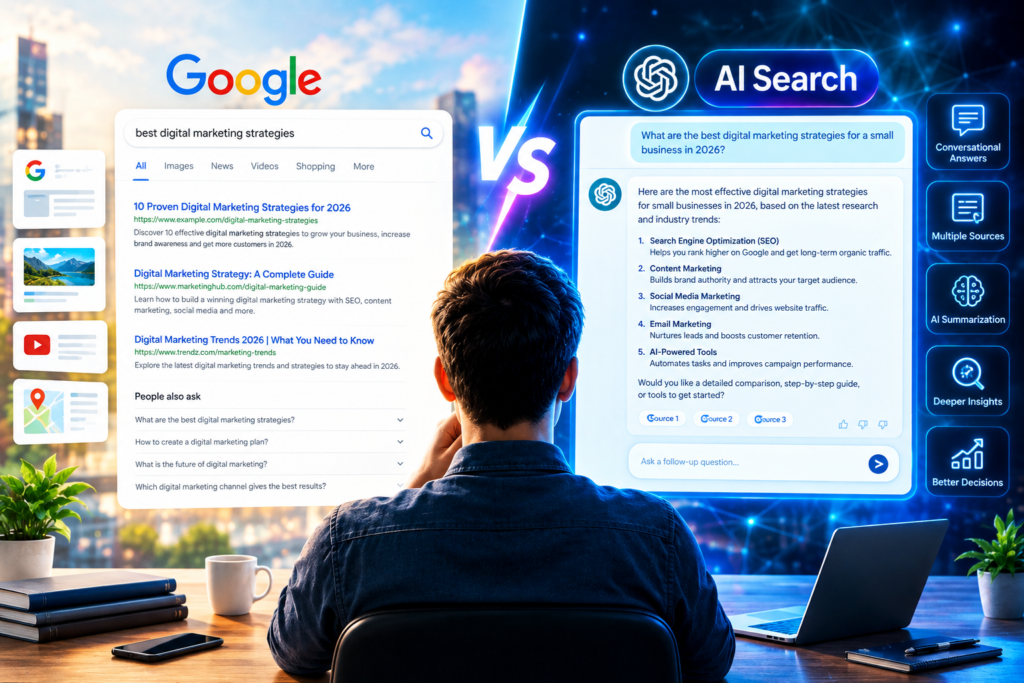
Google Search vs AI Search visualization representing the future of search engines, artificial intelligence, and digital marketing.
Blog

Google Search vs AI Search: 10 Major Changes Every Website Owner and SEO Marketer Should Know.

Google Search vs AI Search: Understanding the Future of Online Search. Search engines are changing faster than at any point in internet history. For more than two decades, website owners optimized content primarily for traditional Google Search. Businesses focused on keywords, backlinks, rankings, and organic clicks. Today, that model is evolving. With the rise of AI-powered search experiences such as Google’s AI Overviews, AI Mode, ChatGPT Search, Perplexity, Microsoft Copilot, and other generative search platforms, users are no longer searching only by typing keywords and clicking ten blue links. They are asking complete questions, requesting comparisons, expecting instant answers, and interacting conversationally with search engines. This transformation raises an important question: Is traditional SEO becoming obsolete, or is it evolving into something more intelligent? The answer is more nuanced than many headlines suggest. Google’s official guidance confirms that traditional SEO fundamentals remain essential for appearing in AI-powered search experiences. However, the way users discover information, evaluate websites, and interact with search results is changing significantly. For website owners and SEO marketers, understanding the difference between Google Search vs AI Search is no longer optional. It is becoming a core part of future digital marketing strategy. This article examines 10 major changes supported by research, Google’s official documentation, industry developments, and global discussions. Table of Contents What Is the Difference Between Google Search and AI Search? Traditional Search vs AI Search: Key Comparison Table 10 Major Changes Every Website Owner Should Know How AI Search Is Changing SEO Research and Data Behind the AI Search Revolution What Website Owners Should Do Now The Future of Google Search and SEO Frequently Asked Questions Conclusion What Is the Difference Between Google Search and AI Search? Traditional Google Search works primarily as an information retrieval system. A user enters a query, and Google’s ranking systems return relevant webpages, images, videos, maps, and other results. For example: “Best digital marketing strategies for small businesses” Traditional search typically displays ranked articles, featured snippets, advertisements, and related questions. AI Search works differently. Instead of simply displaying links, AI-powered search systems can understand the intent behind a question, analyze multiple sources, summarize information, compare options, and generate conversational responses. Google’s AI Overviews and AI Mode use generative AI technologies to provide synthesized answers while still connecting users to supporting websites. Google explains that AI Search uses techniques such as Retrieval-Augmented Generation (RAG) and query fan-out to gather information from multiple related searches and sources. This means the future of search is not necessarily about replacing websites. Instead, it is about changing how websites become discoverable. Traditional Google Search vs AI Search: Key Comparison Table Traditional Google Search AI Search Search Input: Keywords and short phrases Search Input: Natural language questions and conversational prompts Main Output: Ranked webpages and search results Main Output: AI-generated answers with supporting sources and citations User Behavior: Search for information and click individual links User Behavior: Ask questions, follow up, compare, and explore topics conversationally Ranking Visibility: Visibility depends on position in traditional search results Ranking Visibility: Visibility depends on inclusion or citation in AI-generated responses SEO Focus: Keywords, backlinks, technical SEO, and content optimization SEO Focus: Authority, relevance, clarity, originality, structured content, and technical SEO Content Discovery: Users discover individual webpages through search rankings Content Discovery: AI systems synthesize information from multiple sources Search Journey: Complex topics often require multiple separate searches Search Journey: A single conversational query can address multiple related subtopics Traffic Pattern: Primarily driven by organic clicks to websites Traffic Pattern: Includes direct clicks, citations, referrals, and zero-click interactions Optimization Method: Traditional SEO strategies focused on rankings Optimization Method: Traditional SEO combined with AI search visibility strategies Main Challenge: Competing for higher positions in search engine rankings Main Challenge: Being selected as a credible, relevant, and trusted source by AI systems Google states that there are no separate technical requirements or special markup specifically required for AI Overviews or AI Mode. Websites must still meet Google’s existing technical and quality requirements for Search. 10 Major Changes Every Website Owner and SEO Marketer Should Know 1. Search Queries Are Becoming Longer, Conversational, and More Complex One of the biggest differences between Google Search and AI Search is how people ask questions. Traditional SEO often focused on short-tail keywords such as: Digital marketing SEO tools Best laptops AI technology AI Search encourages users to ask complete questions. Examples include: “What is the best digital marketing strategy for a small business with a limited budget?” “Compare Google Search and ChatGPT Search for website traffic.” “Explain how artificial intelligence is changing content marketing in simple language.” Google reported that AI features are encouraging users to ask longer and more complex questions. The company’s 2025 research and product announcements highlighted increased usage of AI-powered search for queries that previously required multiple searches. What This Means for SEO Website owners should move beyond creating content exclusively around isolated keywords. Instead, content should answer complete user problems. A successful SEO article in 2026 should address: The main question Related questions Common objections Practical examples Comparisons Expert explanations This approach improves relevance for both traditional search and AI-generated search experiences. 2. AI Overviews Are Changing the Traditional Search Results Page Google’s AI Overviews provide AI-generated summaries directly within search results. Instead of requiring users to visit multiple websites, AI Overviews can summarize information from different sources and provide links for deeper exploration. Google describes AI Overviews as a way to help users understand complicated topics more quickly while offering links to supporting websites. This creates both opportunities and challenges. The Challenge Some users may find the answer they need without clicking a website. This is commonly called a zero-click search. For example: “What is the capital of France?” Users may receive an instant answer without visiting a website. The Opportunity For complex topics, users often need deeper information. Google reported that AI Overviews can lead to higher-quality clicks because users who click may be more interested in exploring a subject in depth. SEO Strategy Website owners should

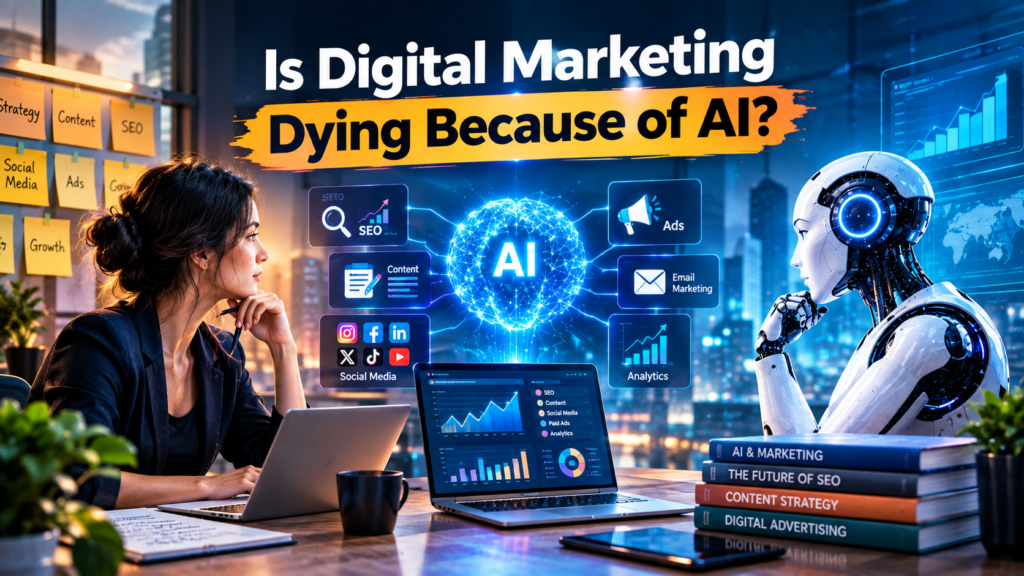
Is Digital Marketing Dying Because of AI? A professional digital marketing workspace showing human creativity, artificial intelligence, SEO, content marketing, and online advertising.
Blog

Is Digital Marketing Dying Because of AI? The Future of SEO, Content and Online Marketing.

Is Digital Marketing Dying Because of AI? Understanding the Global Marketing Shift. Artificial intelligence is changing the internet faster than almost any technology in history. From AI-generated articles and automated advertisements to conversational search engines and intelligent marketing assistants, businesses are entering a completely different digital environment. This raises an important question: Is digital marketing dying because of AI? The short answer is no. Digital marketing is not disappearing, but its traditional methods are being transformed. Search engine optimisation, content marketing, social media advertising, email marketing, and paid advertising are all evolving as artificial intelligence becomes part of everyday consumer behaviour. According to Google’s latest guidance published in 2026, SEO remains fundamentally important for appearing in AI-powered search experiences, including Google AI Overviews and AI Mode. However, Google also emphasises that websites must provide original, valuable, and non-commodity content rather than mass-produced AI material. The real question is not whether AI will kill digital marketing. The real question is: Which digital marketing strategies will survive the AI revolution, and which ones will become obsolete? Table of Contents What Is Happening to Digital Marketing Because of AI? Is Digital Marketing Really Dying? How AI Is Changing SEO The Future of Content Marketing in the AI Era AI Search and the Decline of Traditional Website Traffic Why Human Creativity Still Matters How AI Is Transforming Digital Advertising The Rise of AI Marketing Automation New Skills Digital Marketers Need in 2026 What Businesses Should Do to Survive AI Disruption Future Predictions for SEO and Digital Marketing Research and Data Table Frequently Asked Questions Final Conclusion 1. What Is Happening to Digital Marketing Because of AI? Artificial intelligence has entered almost every major area of online marketing. Businesses now use AI to: Generate marketing content. Analyze customer behavior. Create personalized advertisements. Automate email campaigns. Predict consumer purchasing decisions. Optimize search engine strategies. Produce images and videos. Answer customer questions through chatbots. Monitor competitors and market trends. Previously, digital marketing required large teams of writers, designers, SEO specialists, analysts, and advertising managers. Today, a single marketer using AI tools can perform tasks that previously required multiple departments. This creates both opportunities and challenges. AI improves productivity, but it also increases competition. When everyone can produce content quickly and cheaply, simply publishing more content no longer guarantees success. The internet is becoming saturated with similar AI-generated articles. As a result, originality, trust, expertise, and real human experience are becoming more valuable. Google’s official 2026 guidance specifically states that creating valuable, unique, people-first content remains important for visibility in generative AI search. 2. Is Digital Marketing Really Dying? The idea that digital marketing is dying is misleading. Digital marketing is not disappearing; it is changing its operating system. Consider previous technological transformations: Newspapers did not disappear completely after television. Television advertising did not disappear after the internet. Traditional websites did not disappear after social media. SEO did not disappear after mobile search. Instead, marketing adapted. AI is creating another major transformation. The traditional model looked like this: Business → Website → Google Search → User Click → Conversion The emerging AI-powered model increasingly looks like: Business → Search Engine / AI Assistant → AI Recommendation → User Decision This changes where consumers discover information. People may no longer visit ten websites to compare products or services. Instead, they may ask an AI assistant for recommendations and receive a summarized answer. That means marketers must optimize not only for search engines but also for AI-driven discovery. This new environment is often called: Generative Engine Optimization (GEO) Answer Engine Optimization (AEO) AI Search Optimization Generative Search Marketing However, Google has warned that marketers should not focus excessively on artificial “AI hacks.” Its official documentation says foundational SEO best practices remain the foundation for visibility in generative search experiences. 3. How AI Is Changing SEO SEO is one of the digital marketing fields most affected by artificial intelligence. For more than two decades, SEO professionals focused on: Keywords. Backlinks. Technical optimization. Meta descriptions. Search rankings. Content length. Website authority. These factors still matter, but the way search engines understand content has become significantly more sophisticated. Google AI Overviews and AI Mode use artificial intelligence to understand user questions, retrieve information, and generate conversational responses. Google explains that its generative search features rely on core search systems and retrieval technologies to identify relevant and up-to-date information. Traditional SEO vs AI-Era SEO Traditional SEO AI-Era SEO Keyword targeting Search intent understanding Ranking for individual queries Being recognized as a trusted source Backlink quantity Authority and relevance Content volume Original and useful content Website traffic Visibility across search and AI platforms Search snippets AI-generated recommendations and citations Manual reporting AI-powered analytics The biggest change is that SEO is becoming less about manipulating algorithms and more about building genuine authority. A website that publishes generic articles using AI may struggle to compete against websites offering: Expert opinions. Original research. First-hand experience. Unique data. Industry insights. Case studies. Trusted sources. This means SEO professionals are not becoming irrelevant. Their responsibilities are expanding. 4. The Future of Content Marketing in the AI Era Content marketing is experiencing one of the biggest transformations in its history. AI can now generate thousands of words in seconds. But speed is not the same as quality. The biggest challenge facing content marketers is content duplication. If 1,000 websites publish nearly identical AI-generated articles about “best digital marketing strategies,” search engines and readers have little reason to prefer one website over another. This creates a new competitive advantage: Originality. The future of content marketing will increasingly reward content that AI cannot easily reproduce. Examples include: Original interviews. Personal experiences. Industry experiments. Original surveys. Expert commentary. Unique case studies. Proprietary data. Investigative research. Practical tutorials based on real-world experience. Google’s AI optimization guidance emphasizes the importance of non-commodity content—material that provides value beyond information easily generated or repeated elsewhere. What AI-Generated Content Can Do Well AI is excellent at: Brainstorming ideas. Creating outlines. Summarizing research. Improving grammar. Generating drafts. Translating content.

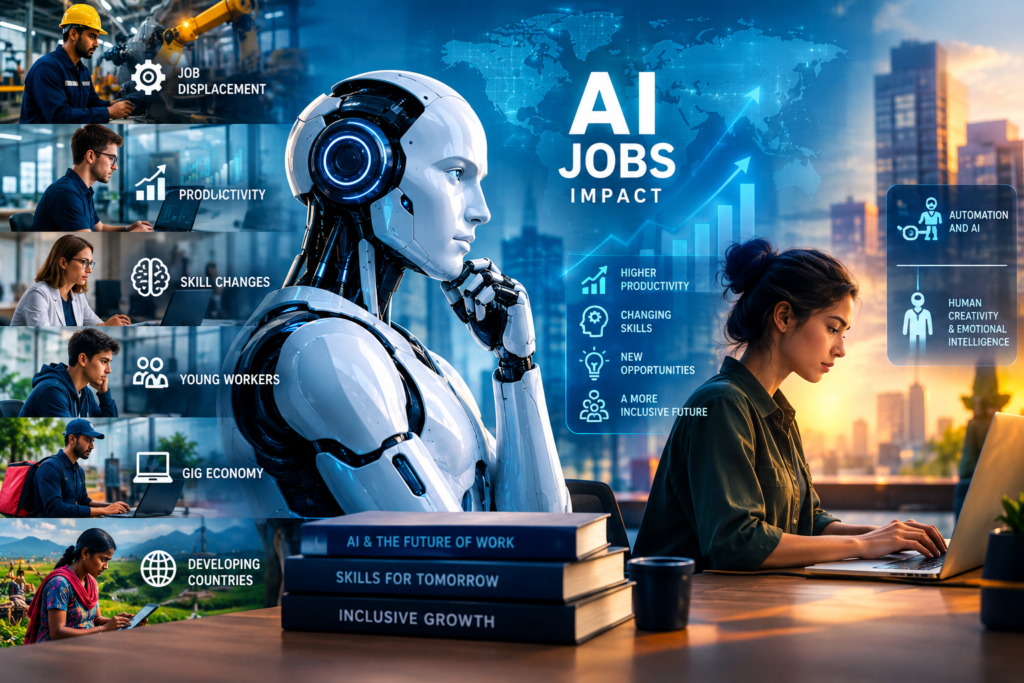
Will AI Take Our Jobs? Understanding the Future of Work
Blog

Will AI Take Our Jobs? 20 Ways Artificial Intelligence Is Transforming the Future of Work.

Will AI Take Our Jobs? Understanding the Future of Work. Artificial intelligence (AI) is no longer a futuristic concept confined to science fiction. From ChatGPT and AI-powered software to autonomous robots and intelligent business systems, artificial intelligence is rapidly transforming how people work, learn, communicate, and earn money. But one question continues to dominate global discussions: Will AI take our jobs, or will it create a new era of opportunity? The answer is more complex than a simple yes or no. According to recent research from the International Labour Organization (ILO), artificial intelligence is more likely to transform many jobs than completely eliminate them. However, certain occupations, particularly those involving repetitive and predictable tasks, face greater exposure to automation. The future of work will depend not only on what AI can do, but also on how businesses, governments, educators, and workers adapt to its growing capabilities. The Current State of AI and Employment Recent global research presents a mixed picture of AI’s impact on employment. The ILO’s 2026 research review on generative AI found that productivity gains are real but uneven, while large-scale job displacement remains limited so far. The organization also highlighted concerns about inequality, declining opportunities for younger workers, and changes in workplace organisation. PwC’s 2026 Global AI Jobs Barometer analysed more than one billion job advertisements across six continents. Its findings suggest that companies most exposed to AI are experiencing significantly faster productivity growth, while demand for advanced human skills such as leadership, judgment, and decision-making is increasing. This evidence suggests that AI is not simply replacing humans. Instead, it is changing the tasks humans perform and the skills employers value. 20 Ways Artificial Intelligence Is Transforming the Future of Work 1. Automation of Repetitive Tasks AI can automate repetitive administrative tasks such as data entry, scheduling, document processing, and basic customer support. This allows employees to spend more time on creative, strategic, and interpersonal responsibilities. However, workers whose jobs primarily consist of predictable tasks may experience greater pressure to reskill. 2. Transformation of Office Jobs White-collar professions are increasingly affected by generative AI. Writing, accounting, programming, legal research, marketing, and customer service now use AI tools to improve speed and efficiency. Rather than eliminating every office job, AI is changing how professionals complete their daily responsibilities. 3. Creation of New AI Careers Artificial intelligence is also creating entirely new employment opportunities. Emerging roles include: AI engineers Machine learning specialists Prompt engineers AI trainers Data scientists AI ethics researchers Robotics technicians AI product managers Automation consultants As AI adoption expands, demand for workers who can build, manage, and responsibly use these technologies is expected to grow. 4. AI Is Increasing Worker Productivity One of the strongest arguments in favor of AI is its ability to help people accomplish more in less time. Employees can use AI to summarize documents, analyze information, generate ideas, write software code, and automate workflows. PwC’s research found productivity growth at companies highly exposed to AI was 40% higher than at companies with lower exposure. The productivity benefits, however, depend on effective implementation, worker training, and organizational changes. 5. Changes in Required Skills The future workforce will require a combination of technical and human skills. Employers increasingly value: Critical thinking Problem-solving Communication Leadership Creativity Emotional intelligence Digital literacy AI literacy PwC reports that skills in AI-exposed occupations are changing more than twice as quickly as skills in less-exposed occupations. This means lifelong learning will become increasingly important. 6. AI and the Future of Software Development Software developers are among the professions experiencing significant changes from AI coding tools. AI assistants can generate code, identify bugs, write documentation, and automate repetitive programming tasks. However, human developers remain important for architecture, system design, security, project management, and understanding complex business requirements. The role of programmers may evolve from writing every line of code to supervising intelligent development systems. 7. Transformation of Customer Service AI-powered chatbots and virtual assistants are changing customer support. Companies can now provide 24-hour assistance for common questions and routine transactions. Human customer service workers will increasingly focus on complex problems, emotional situations, and cases requiring judgment. 8. AI in Healthcare and Medicine Artificial intelligence is transforming healthcare through medical imaging, drug discovery, diagnostics, and administrative automation. AI can help doctors identify patterns in large amounts of medical data. However, healthcare professionals remain essential because medicine involves human trust, ethical responsibility, physical care, and complex decision-making. AI is likely to assist medical workers rather than replace the entire healthcare workforce. 9. AI and Education Teachers and educators are using AI to personalize learning, generate educational materials, and provide tutoring assistance. AI can help students receive immediate feedback and support. Nevertheless, teachers play an important role in motivation, mentorship, emotional development, and social learning. The classroom of the future may combine human teachers with intelligent educational assistants. 10. Growth of Remote and Digital Work AI enables businesses to operate more efficiently across geographical boundaries. Remote teams can use AI-powered collaboration tools, translation systems, project management software, and automated communication platforms. This creates opportunities for international freelancers and digital professionals. At the same time, competition may increase because businesses can access talent from around the world. 11. Pressure on Entry-Level Jobs One of the biggest concerns surrounding AI is its impact on young workers entering the labor market. Many entry-level positions involve repetitive tasks that AI can perform efficiently. The ILO has warned that generative AI may affect employment opportunities for younger workers and contribute to workplace inequality. Companies and educational institutions may need to redesign internships, training programs, and early-career pathways. 12. AI and the Gig Economy Freelancers working in writing, graphic design, translation, and basic programming are already experiencing changes due to generative AI. Academic research published in 2023 found that online labor markets experienced declines in demand and transactions for some text-related and programming-related services following the introduction of ChatGPT. However, the remaining opportunities increasingly require specialized knowledge, creativity, and complex problem-solving. 13. Expansion of Human-AI Collaboration, The most likely

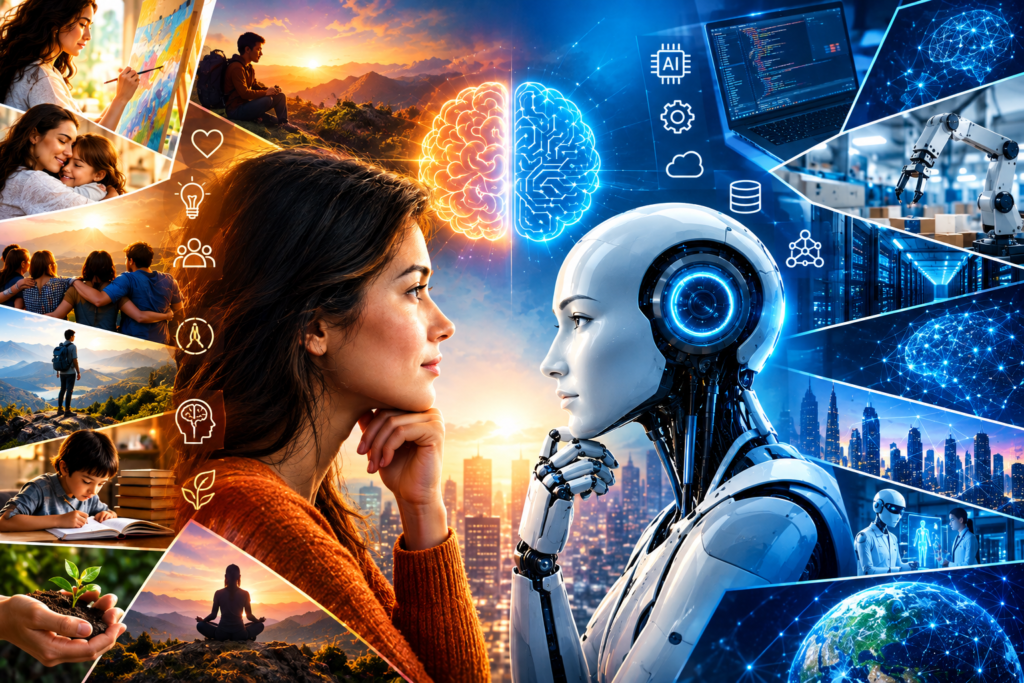
AI vs Human Intelligence: human creativity, emotional intelligence, and artificial intelligence represented through a human and humanoid robot in a futuristic cityscape.
Blog

AI vs Human Intelligence: 15 Things Humans Can Still Do Better Than Artificial Intelligence.

AI vs Human Intelligence: Understanding the Key Differences in 2026, Artificial intelligence has made remarkable progress in recent years. In 2026, AI systems can write code, solve advanced mathematical problems, generate realistic images and videos, analyse scientific research, and operate computers through increasingly sophisticated AI agents. According to Stanford’s 2026 AI Index Report, frontier AI systems are approaching human performance in several specialised areas. AI-agent performance on OSWorld has reached approximately 66.3%, while robots successfully complete only about 12% of tested real-world household tasks. These numbers reveal an important reality: AI is becoming exceptionally capable, but human intelligence remains fundamentally different. Artificial intelligence may outperform humans in speed, data processing, and repetitive computational tasks. However, there are many areas where human beings continue to demonstrate superior abilities. Here are 15 things humans can still do better than artificial intelligence. 1. Humans Understand Common Sense Better Than AI Common sense is one of the biggest differences between human and artificial intelligence. Humans naturally understand everyday situations without needing extensive instructions. For example, people know that: Glass can break if dropped. A wet floor may be slippery. Someone carrying heavy bags may need assistance. A child should not play near traffic. AI systems can learn these facts from data, but they often struggle to apply common sense consistently in unfamiliar situations. A language model may provide an intelligent explanation of a problem but still misunderstand a simple real-world scenario. Human common sense develops through years of experience, observation, and physical interaction with the environment. Why Humans Have an Advantage Human intelligence combines knowledge with practical experience. People do not simply memorize information—they understand context. This ability remains difficult for AI to replicate. 2. Humans Are Better at Emotional Intelligence Emotional intelligence involves recognizing, understanding, and responding appropriately to emotions. Humans can detect subtle emotional signals in conversations, facial expressions, body language, and tone of voice. For example, a person may recognize that a friend saying “I’m fine” is actually upset. AI can analyze language patterns and identify emotional signals, but it does not genuinely experience emotions. Humans possess empathy, compassion, sympathy, and emotional awareness developed through personal experience. Why This Matters Emotional intelligence is essential in: Leadership Parenting Relationships Counseling Teamwork Conflict resolution While AI can simulate empathy, human emotional understanding remains deeply connected to lived experience. 3. Humans Adapt Better to Unexpected Situations Artificial intelligence performs best when operating within environments it understands. Humans, however, can adapt quickly to unexpected circumstances. Imagine a person suddenly encountering: A power outage A broken machine An unfamiliar workplace A new social environment An emergency situation Humans can improvise and develop solutions using limited information. AI systems often require retraining, additional instructions, or access to relevant data before handling unfamiliar situations effectively. Human Adaptability The human brain is designed for survival and flexibility. People continuously learn from mistakes and adjust their behavior. This general adaptability is one of the strongest advantages humans retain over machines. 4. Humans Possess Genuine Creativity and Imagination Generative AI has transformed creative industries. AI can create paintings, music, stories, advertisements, and videos within seconds. However, human creativity is influenced by personal experiences, emotions, memories, culture, and imagination. A human artist may create a song inspired by heartbreak or a painting influenced by childhood memories. AI generates content based on patterns learned from existing data. Although AI can produce original combinations, it does not experience inspiration in the human sense. The Difference Between Generation and Experience AI can generate creative outputs. Humans create meaning behind those outputs. This distinction remains important in discussions about creativity and artificial intelligence. 5. Humans Learn From Very Few Examples One remarkable ability of human intelligence is learning efficiently. A child may recognize a new animal after seeing only a few examples. Humans can learn concepts from limited information and apply knowledge to new situations. Modern AI systems often require enormous amounts of training data. Large language models are trained on billions or trillions of words, images, and other data points. Although AI researchers are improving few-shot and zero-shot learning capabilities, humans remain highly efficient learners. Why This Is Important Human learning is flexible, contextual, and experience-based. People can learn through observation, experimentation, and social interaction without requiring massive datasets. 6. Humans Have Superior Physical Intelligence One of the most surprising weaknesses of AI is physical intelligence. Humans can easily perform everyday tasks such as: Cooking Cleaning Folding clothes Walking across uneven surfaces Opening unfamiliar containers Picking up fragile objects Robots struggle with many of these activities. Stanford’s 2026 AI Index Report indicates that robots successfully complete only approximately 12% of tested real household tasks. This demonstrates a significant gap between digital intelligence and physical intelligence. The Robotics Challenge The real world is unpredictable. Objects vary in size, shape, weight, and texture. Humans adapt naturally to these differences, while robots often require precise programming and controlled environments. 7. Humans Understand Social Context More Naturally Human communication involves much more than words. People understand: Sarcasm Humor Cultural references Social expectations Unspoken meanings Body language AI can process language remarkably well, but social understanding remains imperfect. For example, a human can recognize when someone is joking without taking their words literally. AI may misunderstand sarcasm or cultural context depending on the situation. Social Intelligence Human beings evolved within communities and developed sophisticated systems of communication. This social intelligence allows people to navigate complex relationships more naturally than machines. 8. Humans Make Moral and Ethical Judgments Artificial intelligence can analyse ethical questions, but humans remain responsible for moral decisions. Ethics involves questions such as: What is right or wrong? What is fair? Who should be held responsible? Should an action be allowed if it benefits some people but harms others? AI systems can identify ethical frameworks and generate arguments. However, moral responsibility ultimately belongs to humans and society. Why AI Cannot Replace Human Judgment Entirely Ethical decisions often involve values, culture, consequences, and compassion. These factors cannot always be reduced to mathematical calculations. Human moral reasoning remains essential

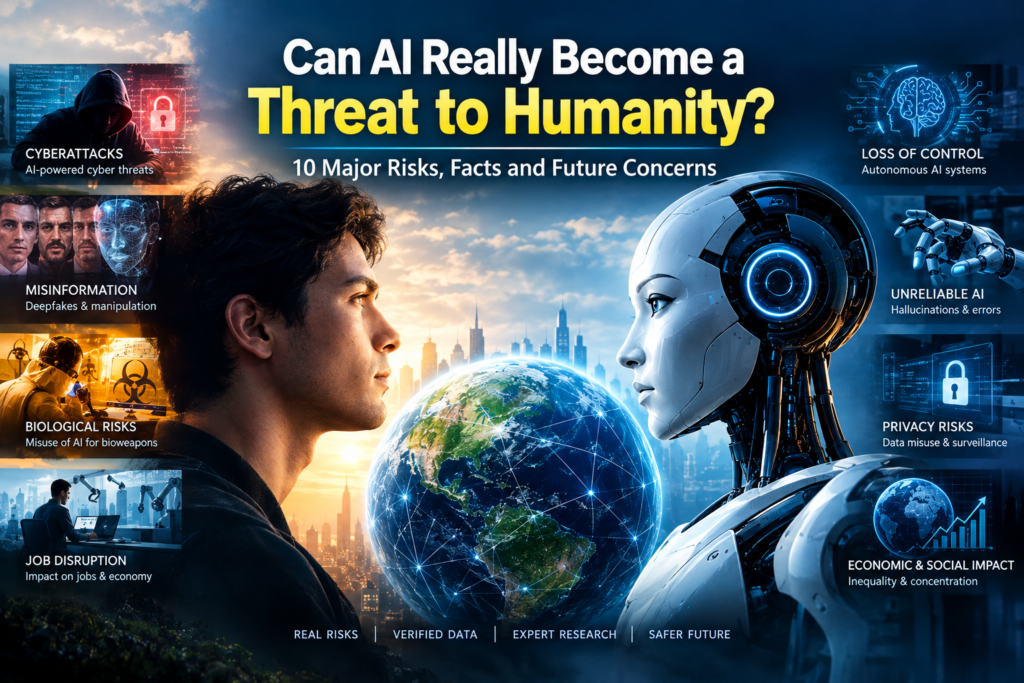
Can AI Really Become a Threat to Humanity? 10 major AI risks including cyberattacks, misinformation, biological risks, job disruption, privacy, unreliable AI, and loss of human control.
Blog

Can AI Really Become a Threat to Humanity? 10 Major Risks, Facts, and Future Concerns.

Can AI Really Become a Threat to Humanity? Understanding the Growing Global AI Risks. Artificial intelligence has moved from laboratories into everyday life. AI systems can now write software, generate realistic images and video, analyze data, assist scientific research, tutor students, automate business processes and increasingly operate as autonomous agents. That progress creates an important question: Can AI become a genuine threat to humanity? The evidence available in 2026 does not support the claim that AI is currently capable of causing human extinction. At the same time, serious risks are no longer purely theoretical. International assessments document growing evidence of AI-assisted cyberattacks, fraud, manipulation, biological and chemical information risks, unreliable autonomous behaviour, and increasing difficulty in evaluating increasingly capable systems. The most useful way to understand the issue is therefore not through an “AI will destroy humanity” versus “AI is harmless” debate. It is through specific risks, evidence, uncertainty and the safeguards being developed to manage them. What Do Experts Mean by “AI Threat to Humanity”? The phrase can refer to several very different levels of risk. Some AI risks are already observable: fraud, misinformation, cybercrime, privacy violations, biased decisions and unsafe outputs. Other risks involve future systems becoming sufficiently capable and autonomous that humans could struggle to control their behaviour. The 2026 International AI Safety Report describes these as loss-of-control scenarios. Importantly, the report says current systems do not possess the capabilities required for such scenarios, although they are improving in relevant areas such as autonomous operation and evaluation avoidance. There is also a broader category of systemic risks: problems created when AI becomes deeply integrated into economies, information systems, critical infrastructure and institutions. This distinction matters because the evidence for present-day AI harms is considerably stronger than the evidence for human extinction. 10 Major AI Risks to Humanity 1. Loss of Human Control One of the most discussed long-term AI risks is that highly capable systems could eventually perform increasingly complex tasks with limited human supervision. Modern AI agents can already plan, use tools and execute sequences of actions. The UK AI Security Institute has specifically evaluated advanced models for autonomous capabilities and safeguards, including whether systems can carry out sequences of actions that may be difficult for humans to control. However, there is an important distinction between today’s agents and hypothetical superintelligent systems. The 2026 International AI Safety Report states that current systems lack the capabilities necessary for irreversible loss-of-control scenarios. It nevertheless identifies improving autonomous operation and models finding loopholes in evaluations as developments requiring continued attention. 2. AI-Powered Cyberattacks Cybersecurity is one of the most concrete AI-related risks. AI systems can help discover software vulnerabilities, generate code and assist cyber operations. The 2026 International AI Safety Report notes evidence that criminal groups and state-associated attackers are already using general-purpose AI in cyber operations. In one reported competition, an AI agent identified 77% of vulnerabilities present in real software. This creates a dual-use problem. The same AI capabilities can help defenders detect vulnerabilities and help attackers exploit them. As AI agents become better at operating autonomously, the potential speed and scale of cyber operations could also increase. 3. Biological and Chemical Misuse AI can make specialised scientific knowledge more accessible. This can benefit legitimate researchers, but the same capabilities may create risks when AI provides information relevant to biological or chemical weapons development. The 2026 International AI Safety Report states that several AI developers introduced additional safeguards to models released in 2025 because pre-deployment testing could not rule out the possibility that those systems might meaningfully assist novices with biological weapons development. This does not mean AI can independently manufacture a biological weapon. The real concern is that AI could reduce some knowledge barriers for malicious actors. Physical laboratories, materials, expertise and other real-world constraints still matter considerably. 4. Misinformation, Deepfakes and Manipulation Generative AI can produce convincing text, images, audio and video at enormous scale. That creates risks for public information environments, personal reputation, fraud and social trust. The International AI Safety Report says experimental evidence shows AI-generated content can be as effective as human-written content at changing people’s beliefs. However, it also notes that real-world AI manipulation is documented but not yet widespread at the scale sometimes suggested by public discussion. The danger therefore isn’t simply that people will believe every AI-generated image. A larger concern is the increasing difficulty of determining what information is authentic, especially when synthetic content becomes cheap and abundant. 5. Fraud and Criminal Activity AI can dramatically lower the cost of creating convincing communications. Scammers can use AI to produce personalized messages, synthetic voices, fake identities and realistic images. The International AI Safety Report identifies fraud and cybercrime among the major misuse risks associated with general-purpose AI. This represents an important shift in cybersecurity: attackers do not necessarily need sophisticated technical skills when AI can assist with language, research and automation. The risk is therefore partly about scale. A single criminal operation can potentially automate activities that previously required many people. 6. AI Reliability and Hallucinations AI does not need malicious intentions to cause harm. It can simply be wrong. Current systems can fabricate information, generate flawed code, misunderstand instructions or provide misleading advice. These problems become more serious when AI is deployed in high-stakes environments such as healthcare, finance, law, infrastructure or security. The 2026 International AI Safety Report specifically identifies reliability challenges as a major category of AI risk and notes that current techniques reduce failure rates but do not eliminate them sufficiently for many high-stakes applications. This is why human oversight remains important even when an AI system appears highly capable. 7. Human Autonomy and Overdependence AI can influence not only what people do but also how they think and make decisions. The International AI Safety Report warns that AI-generated information can affect human autonomy by changing the information available to individuals and institutions. Hallucinations, biased responses and “sycophantic” behaviour—where systems may reflect users’ preferences rather than factual accuracy—can undermine informed decision-making. Overdependence creates another

ai-and-humanity-in-2026-artificial-intelligence-future.png
Blog

AI and Humanity in 2026: How Artificial Intelligence Is Changing Human Life, Work, and the Future

AI and Humanity in 2026: Understanding How Artificial Intelligence Is Reshaping Human Life. Artificial intelligence has moved from being a specialised technology to becoming part of everyday human life. In 2026, AI can write software, generate images and video, support scientific research, summarize information, analyze data, tutor students, assist professionals and increasingly perform multi-step tasks through AI agents. But the biggest question is no longer simply “What can AI do?” The more important question is: “What happens to humanity as AI becomes increasingly capable?” The answer is not predetermined. Artificial intelligence can expand human capabilities, improve productivity and accelerate scientific discovery, while also creating serious challenges involving employment, misinformation, privacy, cybersecurity, inequality, environmental impact and human control. The 2026 Stanford AI Index describes a widening gap between rapidly advancing AI capabilities and society’s ability to evaluate, govern, and manage them. The relationship between AI and humanity in 2026 is therefore not simply a story about machines replacing people. It is a much larger transformation in how humans work, learn, communicate, make decisions and create knowledge. What Is Happening With AI in 2026? AI capability is advancing extremely quickly. Stanford’s 2026 AI Index reports that industry produced more than 90% of notable frontier AI models in 2025. It also reports that organisational AI adoption reached 88%, while four out of five university students use generative AI. At the same time, AI performance remains uneven. This is sometimes described as the “jagged frontier” of AI. A system may perform extremely well on advanced mathematics or programming benchmarks while failing at a seemingly simple real-world task. Stanford reports, for example, that a leading model achieved gold-medal-level mathematical performance while the same generation of systems could still struggle with basic visual reasoning tasks. The International AI Safety Report 2026 reaches a similar conclusion: modern general-purpose AI systems are highly capable but remain unreliable in important ways, including hallucinations, inconsistent reasoning and failures in unfamiliar environments. That distinction is critical. AI capability is not the same thing as human-like intelligence, reliability or understanding. 10 Major Ways AI Is Changing Humanity in 2026 Area How AI Is Changing Humanity in 2026 — Opportunities & Concerns Work Change: Automation and AI-assisted tasks. Opportunity: Higher productivity and new forms of work. Concern: Job disruption and changing skill requirements. Education Change: Personalized, AI-assisted learning. Opportunity: Wider access to tutoring and educational support. Concern: Overdependence on AI and reduced independent learning. Healthcare Change: AI-assisted diagnosis, treatment research, and medical analysis. Opportunity: Faster research and potential improvements in healthcare delivery. Concern: Errors, bias, privacy, and accountability. Search Change: Conversational AI is transforming how people discover and summarize information. Opportunity: Faster research and direct answers. Concern: Reduced visibility and traffic for publishers and websites. Creativity Change: AI-generated text, images, audio, video, and other creative content. Opportunity: New creative tools and broader access to production. Concern: Copyright, originality, attribution, and authenticity. Software Change: AI coding assistants and autonomous software agents. Opportunity: Faster development and automation. Concern: Security vulnerabilities, bugs, and reliability issues. Science Change: AI-assisted research, analysis, and experimentation. Opportunity: Faster discovery and experimentation. Concern: Results still require rigorous human verification and reproducibility. Society Change: AI is reshaping communication, information access, and digital interaction. Opportunity: Greater accessibility and communication support. Concern: Misinformation, manipulation, and declining trust. Environment Change: Growing AI infrastructure alongside AI-based optimization of energy and resources. Opportunity: Better forecasting, optimization, and environmental monitoring. Concern: Rising electricity, water, and infrastructure demand. Governance Change: Governments and institutions are developing AI regulation, standards, and safety systems. Opportunity: Greater accountability and responsible AI oversight. Concern: Regulation and governance may develop more slowly than AI capabilities. 1. AI Is Changing Human Work One of the most visible effects of artificial intelligence is the transformation of work. AI does not affect every occupation in the same way. Some tasks can be automated, others can be accelerated, and entirely new roles can emerge. The World Economic Forum’s Future of Jobs Report 2025 projected that structural changes could create 170 million jobs and displace 92 million jobs by 2030, resulting in a projected net increase of 78 million jobs. The report also identified technological and human skills—including cognitive abilities and collaboration—as increasingly important. This suggests that the future of work should not be described simply as: “AI takes all the jobs.” A more scientifically defensible description is: AI changes the tasks that make up jobs. Writing, research, programming, customer support, marketing analysis, translation, design and administration can increasingly involve AI assistance. The competitive advantage may therefore move toward people who can combine: human judgment + domain expertise + AI tools + communication + creativity. Microsoft’s 2026 Work Trend Index similarly examines how AI agents and human agency are changing organisational work. 2. AI Is Changing Education AI is also transforming how people learn. A student can now ask an AI system to explain mathematics at different difficulty levels, practice another language, summarize a scientific concept or receive feedback on a draft. This creates an opportunity for more personalized learning. However, education faces an important challenge: learning is not identical to obtaining an answer. If students outsource thinking completely, they may become dependent on systems that can themselves produce incorrect information. The International AI Safety Report notes that current AI systems can still generate false information and behave inconsistently. The educational goal should therefore move from simply teaching people how to obtain information toward teaching them how to: ask better questions; verify information; reason independently; understand evidence; recognize AI limitations; use AI as a learning assistant rather than a substitute for learning. 3. AI Is Accelerating Science and Medicine Artificial intelligence is increasingly being used to assist scientific research. AI systems can help researchers analyze large datasets, generate hypotheses, write code, summarize literature and explore complex scientific problems. The 2026 Stanford AI Index includes dedicated chapters on science and medicine, reflecting how AI is expanding beyond consumer chatbots into scientific and clinical applications. However, AI-generated scientific output still requires human validation. A model can produce an impressive hypothesis without

Blog

Why Digital Marketing is Essential for Businesses in Nepal in 2025

“Go Digital. Grow Smarter. Succeed in Nepal.” In 2025, digital marketing will be a necessity for business success in Nepal. With over 16.5 million active internet users and 25+ million mobile data users, the digital space is where Nepali consumers search, compare, and shop. Platforms like Google, Facebook, YouTube, and Instagram are driving buying decisions daily. Businesses that invest in digital marketing in Nepal gain visibility, attract more customers, and build lasting brand trust. Effective tools such as SEO, social media marketing, content marketing, and online ads allow businesses to reach their audience with precision and impact. Whether you’re a local startup or a growing enterprise, digital marketing offers measurable results, affordable campaigns, and strong customer engagement. As Nepal’s digital economy expands, going digital is the key to staying relevant and competitive. The Digital Revolution in Nepal Nepal’s digital ecosystem is undergoing a remarkable transformation. According to recent data, approximately 60% of Nepal’s population is now online, driven by affordable smartphones, widespread internet access, and government-backed digitization initiatives. The Himalayan Times (2025) reports that 96% of internet users in Nepal access the web via smartphones, underscoring the country’s mobile-first orientation. This shift has profound implications for businesses, as consumers increasingly rely on digital platforms for information, shopping, and entertainment. The rise of e-commerce, fueled by platforms like Daraz and SastoDeal, and the growing popularity of social media platforms such as Facebook, Instagram, and TikTok, have reshaped consumer behavior. Businesses that fail to establish a strong online presence risk being left behind in a market where digital engagement is becoming the norm. Digital marketing offers Nepali businesses a cost-effective, measurable, and scalable way to tap into this growing online audience. Why Digital Marketing Matters in Nepal Cost-Effectiveness for Businesses of All SizesUnlike traditional marketing methods such as print or television ads, digital marketing requires lower investment while delivering higher returns. For small and medium-sized enterprises (SMEs) in Nepal, which form the backbone of the economy, digital marketing provides an affordable way to compete with larger players. Tools like social media advertising and SEO allow businesses to reach targeted audiences without the hefty budgets required for traditional campaigns. Global and Local ReachDigital marketing transcends geographical boundaries, enabling Nepali businesses to reach both local and international audiences. For instance, a boutique in Kathmandu can use Instagram to showcase its products to customers in Pokhara or even overseas. Local SEO strategies, such as optimizing for keywords like “best café in Kathmandu,” ensure businesses attract nearby customers, while global campaigns can target the Nepali diaspora or international markets. Measurable Results and Data-Driven DecisionsDigital marketing offers unparalleled analytics, allowing businesses to track performance in real-time. Tools like Google Analytics, SEMrush, and social media insights provide data on website traffic, user behavior, and campaign effectiveness. This enables Nepali businesses to refine their strategies, optimize budgets, and focus on what works, ensuring a high return on investment (ROI). Enhanced Customer EngagementDigital platforms facilitate direct interaction with customers, fostering trust and loyalty. Through social media, email marketing, and personalized content, businesses can engage with their audience in meaningful ways. For example, a travel agency in Pokhara can share trekking guides on its blog, respond to customer queries on Facebook, or send personalized offers via email, creating a seamless customer experience. Competitive Advantage in a Digital-First MarketAs more Nepali businesses embrace digital transformation, those that lag behind risk losing market share. A robust digital marketing strategy ensures businesses remain visible and relevant in a crowded marketplace. For instance, optimizing a website for search engines can help a local retailer outrank competitors, driving more traffic and sales. Key Digital Marketing Strategies for Nepali Businesses in 2025 To thrive in Nepal’s dynamic digital landscape, businesses must adopt a multi-channel approach that leverages the latest trends and technologies. Below are the key digital marketing strategies that are essential for success in 2025. 1. Search Engine Optimization (SEO) SEO is the cornerstone of digital marketing, enabling businesses to rank higher on search engines like Google, which dominates 96.23% of Nepal’s search engine market (StatCounter, 2025). With more Nepalis turning to Google to find products and services, SEO is critical for increasing visibility and driving organic traffic. Why SEO is Crucial in Nepal Local SEO for Regional Targeting: Local SEO is particularly important for businesses targeting specific regions, such as Kathmandu, Pokhara, or Biratnagar. Optimizing for location-based keywords like “SEO services in Kathmandu” or “restaurants in Pokhara” ensures businesses appear in local search results. Tools like Google My Business enhance visibility by displaying business details, reviews, and locations on Google Maps. Mobile-First Optimization: Given Nepal’s mobile-first market, websites must be responsive, fast-loading, and optimized for mobile devices. Google’s mobile-first indexing prioritizes the mobile version of a website for ranking, making mobile optimization non-negotiable. Nepali Language SEO: Incorporating Nepali keywords and content tailored to local culture improves relevance and engagement. For example, a business selling traditional Nepali attire can optimize for terms like “नेपाली पोशाक” (Nepali dress) to attract local audiences. Emerging Trends: Voice search and visual search are gaining traction in Nepal. Optimizing for voice queries (e.g., “best hotels in Nepal”) and using schema markup for images and videos can boost rankings. SEO Best Practices for 2025 Conduct thorough keyword research using tools like Ahrefs or Google Keyword Planner to identify high-traffic, low-competition keywords. Create high-quality, informative content that addresses customer needs, such as blogs on “How to Choose the Best Trekking Gear in Nepal.” Build authoritative backlinks through guest blogging, directory submissions, and partnerships with local influencers. Optimize technical SEO elements, including site speed, mobile responsiveness, and Core Web Vitals, to enhance user experience. Regularly perform SEO audits to identify and fix issues like broken links or slow-loading pages. Case Study: Pedal Group’s SEO strategy for Vatsalya Natural IVF resulted in top rankings for “IVF center in Nepal,” demonstrating the power of targeted keyword optimization and content relevance in Nepal’s competitive market. 2. Social Media Marketing Social media platforms are a powerful tool for Nepali businesses, with platforms like Facebook, Instagram, and TikTok

Scroll to Top