
AI vs Human Intelligence: Understanding the Key Differences in 2026,
Artificial intelligence has made remarkable progress in recent years. In 2026, AI systems can write code, solve advanced mathematical problems, generate realistic images and videos, analyse scientific research, and operate computers through increasingly sophisticated AI agents.
According to Stanford’s 2026 AI Index Report, frontier AI systems are approaching human performance in several specialised areas. AI-agent performance on OSWorld has reached approximately 66.3%, while robots successfully complete only about 12% of tested real-world household tasks.
These numbers reveal an important reality: AI is becoming exceptionally capable, but human intelligence remains fundamentally different.
Artificial intelligence may outperform humans in speed, data processing, and repetitive computational tasks. However, there are many areas where human beings continue to demonstrate superior abilities.
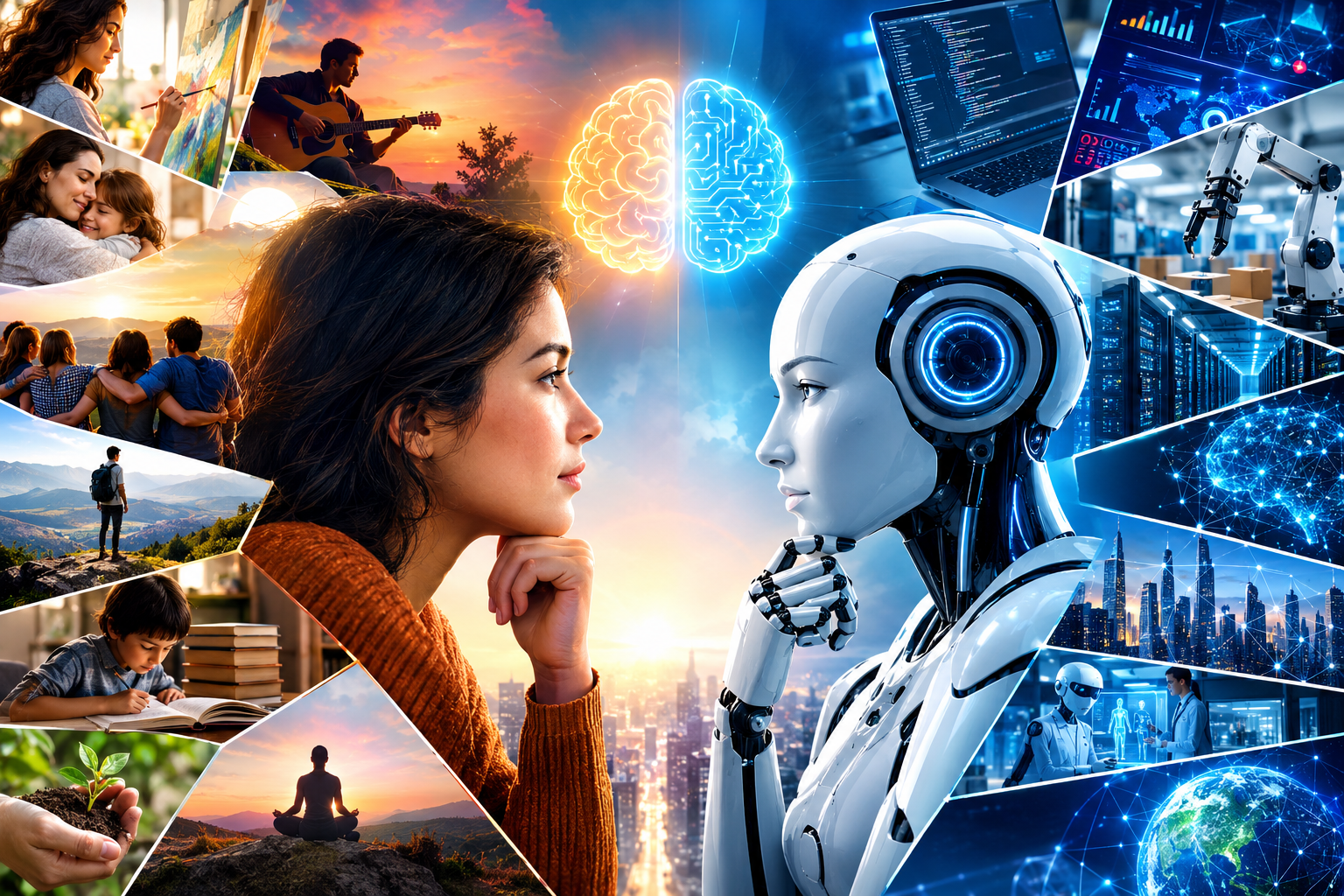
Here are 15 things humans can still do better than artificial intelligence.
1. Humans Understand Common Sense Better Than AI
Common sense is one of the biggest differences between human and artificial intelligence.
Humans naturally understand everyday situations without needing extensive instructions. For example, people know that:
- Glass can break if dropped.
- A wet floor may be slippery.
- Someone carrying heavy bags may need assistance.
- A child should not play near traffic.
AI systems can learn these facts from data, but they often struggle to apply common sense consistently in unfamiliar situations.
A language model may provide an intelligent explanation of a problem but still misunderstand a simple real-world scenario.
Human common sense develops through years of experience, observation, and physical interaction with the environment.
Why Humans Have an Advantage
Human intelligence combines knowledge with practical experience. People do not simply memorize information—they understand context.
This ability remains difficult for AI to replicate.
2. Humans Are Better at Emotional Intelligence
Emotional intelligence involves recognizing, understanding, and responding appropriately to emotions.
Humans can detect subtle emotional signals in conversations, facial expressions, body language, and tone of voice.
For example, a person may recognize that a friend saying “I’m fine” is actually upset.
AI can analyze language patterns and identify emotional signals, but it does not genuinely experience emotions.
Humans possess empathy, compassion, sympathy, and emotional awareness developed through personal experience.
Why This Matters
Emotional intelligence is essential in:
- Leadership
- Parenting
- Relationships
- Counseling
- Teamwork
- Conflict resolution
While AI can simulate empathy, human emotional understanding remains deeply connected to lived experience.
3. Humans Adapt Better to Unexpected Situations
Artificial intelligence performs best when operating within environments it understands.
Humans, however, can adapt quickly to unexpected circumstances.
Imagine a person suddenly encountering:
- A power outage
- A broken machine
- An unfamiliar workplace
- A new social environment
- An emergency situation
Humans can improvise and develop solutions using limited information.
AI systems often require retraining, additional instructions, or access to relevant data before handling unfamiliar situations effectively.
Human Adaptability
The human brain is designed for survival and flexibility. People continuously learn from mistakes and adjust their behavior.
This general adaptability is one of the strongest advantages humans retain over machines.
4. Humans Possess Genuine Creativity and Imagination
Generative AI has transformed creative industries.
AI can create paintings, music, stories, advertisements, and videos within seconds.
However, human creativity is influenced by personal experiences, emotions, memories, culture, and imagination.
A human artist may create a song inspired by heartbreak or a painting influenced by childhood memories.
AI generates content based on patterns learned from existing data.
Although AI can produce original combinations, it does not experience inspiration in the human sense.
The Difference Between Generation and Experience
AI can generate creative outputs.
Humans create meaning behind those outputs.
This distinction remains important in discussions about creativity and artificial intelligence.
5. Humans Learn From Very Few Examples
One remarkable ability of human intelligence is learning efficiently.
A child may recognize a new animal after seeing only a few examples.
Humans can learn concepts from limited information and apply knowledge to new situations.
Modern AI systems often require enormous amounts of training data.
Large language models are trained on billions or trillions of words, images, and other data points.
Although AI researchers are improving few-shot and zero-shot learning capabilities, humans remain highly efficient learners.
Why This Is Important
Human learning is flexible, contextual, and experience-based.
People can learn through observation, experimentation, and social interaction without requiring massive datasets.
6. Humans Have Superior Physical Intelligence
One of the most surprising weaknesses of AI is physical intelligence.
Humans can easily perform everyday tasks such as:
- Cooking
- Cleaning
- Folding clothes
- Walking across uneven surfaces
- Opening unfamiliar containers
- Picking up fragile objects
Robots struggle with many of these activities.
Stanford’s 2026 AI Index Report indicates that robots successfully complete only approximately 12% of tested real household tasks.
This demonstrates a significant gap between digital intelligence and physical intelligence.
The Robotics Challenge
The real world is unpredictable.
Objects vary in size, shape, weight, and texture.
Humans adapt naturally to these differences, while robots often require precise programming and controlled environments.
7. Humans Understand Social Context More Naturally
Human communication involves much more than words.
People understand:
- Sarcasm
- Humor
- Cultural references
- Social expectations
- Unspoken meanings
- Body language
AI can process language remarkably well, but social understanding remains imperfect.
For example, a human can recognize when someone is joking without taking their words literally.
AI may misunderstand sarcasm or cultural context depending on the situation.
Social Intelligence
Human beings evolved within communities and developed sophisticated systems of communication.
This social intelligence allows people to navigate complex relationships more naturally than machines.
8. Humans Make Moral and Ethical Judgments
Artificial intelligence can analyse ethical questions, but humans remain responsible for moral decisions.
Ethics involves questions such as:
- What is right or wrong?
- What is fair?
- Who should be held responsible?
- Should an action be allowed if it benefits some people but harms others?
AI systems can identify ethical frameworks and generate arguments.
However, moral responsibility ultimately belongs to humans and society.
Why AI Cannot Replace Human Judgment Entirely
Ethical decisions often involve values, culture, consequences, and compassion.
These factors cannot always be reduced to mathematical calculations.
Human moral reasoning remains essential in law, healthcare, government, and business.
9. Humans Possess Consciousness and Self-Awareness
Consciousness is one of the deepest mysteries in science.
Humans experience thoughts, emotions, memories, sensations, and a sense of self.
Artificial intelligence processes information and generates responses, but there is no scientific evidence that current AI systems possess subjective consciousness.
This distinction is fundamental.
AI may say:
“I understand how you feel.”
But this statement represents generated language, not necessarily genuine emotional experience.
The Consciousness Question
Scientists and philosophers continue to debate whether machines could ever become conscious.
As of 2026, there is no established scientific evidence demonstrating that modern AI systems possess human-like subjective awareness.
10. Humans Are Better at Original Problem Framing
AI is excellent at solving defined problems.
But humans are often better at identifying which problems are worth solving in the first place.
For example, an AI system can optimize a marketing campaign based on data.
A human entrepreneur may recognize an entirely new market opportunity that has never existed before.
Problem framing requires curiosity, imagination, experience, and understanding of human needs.
Why This Matters
Innovation does not always come from solving existing problems.
Sometimes it comes from asking entirely new questions.
Humans remain especially valuable in this area.
11. Humans Understand Physical Reality Through Experience
Humans understand the physical world through direct interaction.
People know what it feels like to:
- Touch hot water
- Walk on ice
- Carry a heavy object
- Experience rain
- Smell food cooking
AI systems process sensory information through cameras, microphones, and sensors, but they do not experience the world biologically.
This difference affects how humans develop intuition.
Embodied Intelligence
Human intelligence is connected to the body.
Physical experiences contribute to learning, memory, and decision-making.
AI researchers are working toward embodied AI and advanced robotics, but significant challenges remain.
12. Humans Can Build Deep Trust and Relationships
Relationships require more than communication.
They involve trust, loyalty, shared experiences, vulnerability, and emotional connection.
Humans build friendships, families, partnerships, and communities through genuine interaction.
AI assistants can provide companionship-like conversations, but they do not participate in relationships as conscious beings.
The Human Connection
Trust is particularly important in areas such as:
- Healthcare
- Education
- Leadership
- Counseling
- Family relationships
Human presence remains irreplaceable in many emotional and social situations.
13. Humans Can Take Responsibility for Their Actions
Accountability is another major difference between humans and AI.
When a person makes a decision, society can hold that individual responsible.
Artificial intelligence does not possess legal or moral responsibility in the same way.
If an AI system makes a harmful decision, responsibility typically involves the developers, organizations, operators, or institutions using the system.
The Importance of Human Oversight
As AI becomes more powerful, human accountability becomes increasingly important.
Machines can assist with decisions, but humans must remain responsible for how those systems are used.
14. Humans Can Understand Meaning Beyond Data
AI systems are highly effective at processing information.
Humans, however, seek meaning.
People ask questions such as:
- Why am I here?
- What makes life meaningful?
- What should society value?
- What is happiness?
- What is justice?
These questions involve philosophy, spirituality, culture, and personal experience.
AI can discuss these topics intelligently, but discussion is not the same as personal understanding.
Intelligence Beyond Information
Human intelligence is not limited to data processing.
It includes interpretation, purpose, values, and meaning.
These qualities continue to distinguish humans from artificial systems.
15. Humans Can Combine Multiple Forms of Intelligence Naturally
Perhaps the most important advantage humans possess is the ability to combine different types of intelligence simultaneously.
A person can:
- Understand a mathematical problem
- Recognize emotional consequences
- Consider ethical implications
- Adapt physically to the environment
- Communicate socially
- Make a practical decision
All within the same situation.
AI systems are becoming increasingly multimodal, meaning they can process text, images, audio, and video together.
However, integrated human intelligence remains difficult to replicate.
The Future of Intelligence
The strongest future may not involve humans competing directly against AI.
Instead, humans and AI may complement one another.
AI provides speed, scale, and computational power.
Humans provide judgment, creativity, empathy, adaptability, and meaning.
AI vs Human Intelligence: Final Comparison
| Human Strength | AI Strength |
|---|---|
| Emotional intelligence | Data processing |
| Common sense | Computational speed |
| Adaptability | Pattern recognition |
| Creativity and imagination | Content generation |
| Physical intelligence | Digital automation |
| Moral judgment | Mathematical optimization |
| Consciousness | Information processing |
| Social understanding | Large-scale analysis |
| Learning from few examples | Learning from massive datasets |
| Meaning and purpose | Task-specific performance |
Top 5 FAQs About AI vs. Human Intelligence
1. Is Artificial Intelligence More Intelligent Than Humans?
Artificial intelligence can be more capable than humans in certain specialised tasks, including data analysis, mathematical calculations, coding, and information processing. However, AI is not universally more intelligent than humans. Human intelligence includes emotional understanding, common sense, creativity, adaptability, and social awareness—abilities that remain difficult for current AI systems to replicate.
2. Can AI Replace Human Intelligence?
AI can replace or automate many individual tasks, especially repetitive and data-driven work. However, replacing human intelligence entirely is far more complex. Humans still play an essential role in creativity, decision-making, leadership, ethics, emotional intelligence, and physical-world problem-solving. The future is likely to involve collaboration between humans and AI rather than complete replacement.
3. What Are the Main Things Humans Can Do Better Than AI?
Humans continue to outperform AI in several important areas, including emotional intelligence, common sense, understanding social situations, adapting to unexpected environments, physical interaction, moral judgment, and genuine creativity. These abilities come from human experience, consciousness, and interaction with the real world.
4. Will AI Become Smarter Than Humans in the Future?
AI capabilities are developing rapidly, and future systems may become significantly more advanced. However, predicting whether AI will become universally smarter than humans remains uncertain. Intelligence is not limited to one skill or benchmark. While AI may surpass humans in specific areas, general human intelligence involves many interconnected abilities that are difficult to measure with a single test.
5. What Is the Difference Between AI and Human Intelligence?
The main difference between AI and human intelligence is how they learn, reason, and interact with the world. AI learns from large amounts of data and performs tasks using computational systems and algorithms. Humans learn through experience, emotions, social interaction, and physical environments. AI offers speed and scalability, while humans provide adaptability, creativity, empathy, and judgment.
Final Conclusion
The comparison between AI and human intelligence shows that both have unique strengths. Artificial intelligence is transforming industries through automation, advanced computing, and data-driven decision-making. Human intelligence remains essential for understanding emotions, navigating uncertainty, building relationships, and making meaningful decisions.
Rather than asking whether AI will completely replace humans, the more important question is how humans and artificial intelligence can work together effectively. Understanding the strengths and limitations of both will help shape a future where technology supports human progress without replacing the qualities that make human intelligence unique.