
Google Search vs AI Search: Understanding the Future of Online Search.
Search engines are changing faster than at any point in internet history. For more than two decades, website owners optimized content primarily for traditional Google Search. Businesses focused on keywords, backlinks, rankings, and organic clicks.
Today, that model is evolving.
With the rise of AI-powered search experiences such as Google’s AI Overviews, AI Mode, ChatGPT Search, Perplexity, Microsoft Copilot, and other generative search platforms, users are no longer searching only by typing keywords and clicking ten blue links.
They are asking complete questions, requesting comparisons, expecting instant answers, and interacting conversationally with search engines.
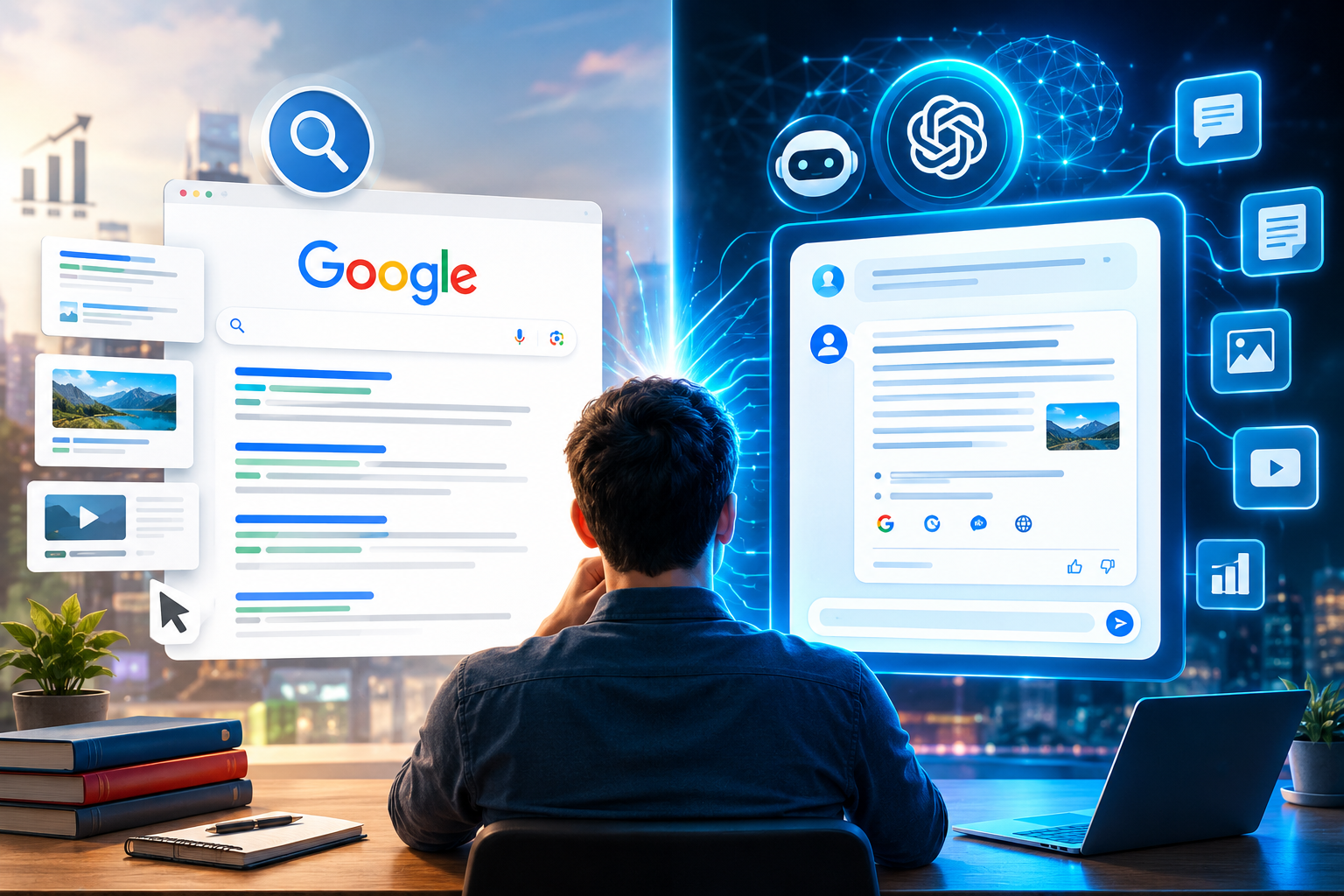
This transformation raises an important question:
Is traditional SEO becoming obsolete, or is it evolving into something more intelligent?
The answer is more nuanced than many headlines suggest.
Google’s official guidance confirms that traditional SEO fundamentals remain essential for appearing in AI-powered search experiences. However, the way users discover information, evaluate websites, and interact with search results is changing significantly.
For website owners and SEO marketers, understanding the difference between Google Search vs AI Search is no longer optional. It is becoming a core part of future digital marketing strategy.
This article examines 10 major changes supported by research, Google’s official documentation, industry developments, and global discussions.
Table of Contents
- What Is the Difference Between Google Search and AI Search?
- Traditional Search vs AI Search: Key Comparison Table
- 10 Major Changes Every Website Owner Should Know
- How AI Search Is Changing SEO
- Research and Data Behind the AI Search Revolution
- What Website Owners Should Do Now
- The Future of Google Search and SEO
- Frequently Asked Questions
- Conclusion
What Is the Difference Between Google Search and AI Search?
Traditional Google Search works primarily as an information retrieval system.
A user enters a query, and Google’s ranking systems return relevant webpages, images, videos, maps, and other results.
For example:
“Best digital marketing strategies for small businesses”
Traditional search typically displays ranked articles, featured snippets, advertisements, and related questions.
AI Search works differently.
Instead of simply displaying links, AI-powered search systems can understand the intent behind a question, analyze multiple sources, summarize information, compare options, and generate conversational responses.
Google’s AI Overviews and AI Mode use generative AI technologies to provide synthesized answers while still connecting users to supporting websites.
Google explains that AI Search uses techniques such as Retrieval-Augmented Generation (RAG) and query fan-out to gather information from multiple related searches and sources.
This means the future of search is not necessarily about replacing websites.
Instead, it is about changing how websites become discoverable.
Traditional Google Search vs AI Search: Key Comparison Table
| Traditional Google Search | AI Search |
|---|---|
| Search Input: Keywords and short phrases | Search Input: Natural language questions and conversational prompts |
| Main Output: Ranked webpages and search results | Main Output: AI-generated answers with supporting sources and citations |
| User Behavior: Search for information and click individual links | User Behavior: Ask questions, follow up, compare, and explore topics conversationally |
| Ranking Visibility: Visibility depends on position in traditional search results | Ranking Visibility: Visibility depends on inclusion or citation in AI-generated responses |
| SEO Focus: Keywords, backlinks, technical SEO, and content optimization | SEO Focus: Authority, relevance, clarity, originality, structured content, and technical SEO |
| Content Discovery: Users discover individual webpages through search rankings | Content Discovery: AI systems synthesize information from multiple sources |
| Search Journey: Complex topics often require multiple separate searches | Search Journey: A single conversational query can address multiple related subtopics |
| Traffic Pattern: Primarily driven by organic clicks to websites | Traffic Pattern: Includes direct clicks, citations, referrals, and zero-click interactions |
| Optimization Method: Traditional SEO strategies focused on rankings | Optimization Method: Traditional SEO combined with AI search visibility strategies |
| Main Challenge: Competing for higher positions in search engine rankings | Main Challenge: Being selected as a credible, relevant, and trusted source by AI systems |
Google states that there are no separate technical requirements or special markup specifically required for AI Overviews or AI Mode. Websites must still meet Google’s existing technical and quality requirements for Search.
10 Major Changes Every Website Owner and SEO Marketer Should Know
1. Search Queries Are Becoming Longer, Conversational, and More Complex
One of the biggest differences between Google Search and AI Search is how people ask questions.
Traditional SEO often focused on short-tail keywords such as:
- Digital marketing
- SEO tools
- Best laptops
- AI technology
AI Search encourages users to ask complete questions.
Examples include:
- “What is the best digital marketing strategy for a small business with a limited budget?”
- “Compare Google Search and ChatGPT Search for website traffic.”
- “Explain how artificial intelligence is changing content marketing in simple language.”
Google reported that AI features are encouraging users to ask longer and more complex questions. The company’s 2025 research and product announcements highlighted increased usage of AI-powered search for queries that previously required multiple searches.
What This Means for SEO
Website owners should move beyond creating content exclusively around isolated keywords.
Instead, content should answer complete user problems.
A successful SEO article in 2026 should address:
- The main question
- Related questions
- Common objections
- Practical examples
- Comparisons
- Expert explanations
This approach improves relevance for both traditional search and AI-generated search experiences.
2. AI Overviews Are Changing the Traditional Search Results Page
Google’s AI Overviews provide AI-generated summaries directly within search results.
Instead of requiring users to visit multiple websites, AI Overviews can summarize information from different sources and provide links for deeper exploration.
Google describes AI Overviews as a way to help users understand complicated topics more quickly while offering links to supporting websites.
This creates both opportunities and challenges.
The Challenge
Some users may find the answer they need without clicking a website.
This is commonly called a zero-click search.
For example:
“What is the capital of France?”
Users may receive an instant answer without visiting a website.
The Opportunity
For complex topics, users often need deeper information.
Google reported that AI Overviews can lead to higher-quality clicks because users who click may be more interested in exploring a subject in depth.
SEO Strategy
Website owners should create content that goes beyond basic definitions.
Instead of only answering:
“What is SEO?”
Create comprehensive content covering:
- How SEO works
- SEO strategies
- Real-world examples
- Industry research
- Common mistakes
- Practical implementation
Basic information may be summarised by AI.
Original, detailed, and useful information gives users a reason to visit your website.
3. Traditional SEO Is Not Dead—But It Is Evolving
One of the biggest misconceptions surrounding AI Search is that SEO is becoming irrelevant.
Google officially states that traditional SEO best practices remain relevant for generative AI features.
Google’s AI systems rely on its Search index and ranking systems to identify relevant and reliable webpages.
This means fundamentals still matter.
Important SEO Fundamentals
- Crawlability
- Indexability
- Website speed
- Mobile usability
- Internal linking
- Structured content
- High-quality backlinks
- Helpful content
- Author credibility
- Technical accessibility
Google specifically states that pages eligible for AI Overviews and AI Mode must generally be indexed and eligible for traditional Search snippets.
The New Reality
SEO is no longer just about ranking #1.
It is increasingly about becoming a trusted and useful source across multiple search experiences.
This includes:
- Traditional Google Search
- AI Overviews
- AI Mode
- Featured snippets
- Voice search
- Conversational search
- Third-party AI search engines
4. Content Quality and Originality Matter More Than Ever
AI can generate thousands of articles within minutes.
This creates a major problem for the internet: content saturation.
If every website publishes identical AI-generated articles, search engines have less reason to prioritize generic content.
Google’s guidance emphasises creating helpful, reliable, people-first content rather than producing large quantities of low-value AI-generated pages.
What Makes Content Valuable in AI Search?
Originality.
AI systems increasingly need reliable information that adds something meaningful to the web.
Examples of valuable content include:
- Original research
- First-hand experiences
- Expert interviews
- Unique case studies
- Industry surveys
- Proprietary data
- Detailed tutorials
- Expert analysis
- Updated statistics
Example
Weak Content:
“SEO is important because it helps websites rank higher.”
Stronger Content:
“According to Google’s Search guidance, AI-powered search still depends on indexed, high-quality webpages. This means technical SEO remains important, but websites should also develop original research and expert-led content to remain valuable in increasingly conversational search environments.”
The second example provides context, evidence, and original interpretation.
That is the direction modern content marketing should take.
5. AI Search Is Creating a New Visibility Metric: Being Cited or Mentioned
Traditional SEO measures success through:
- Keyword rankings
- Organic traffic
- Click-through rates
- Backlinks
- Domain authority
AI Search introduces another important concept:
Citation visibility.
A website may not rank first traditionally but could still be referenced inside an AI-generated response.
For example, when a user asks an AI search engine:
“What are the best SEO strategies for 2026?”
The system may summarize information from several websites.
A brand’s visibility depends not only on ranking position but also on whether its content is selected as a trustworthy source.
This has led to growing discussions around:
- Generative Engine Optimization (GEO)
- Answer Engine Optimization (AEO)
- AI Search Optimization
However, Google specifically advises that these concepts should not be treated as replacements for SEO. Google’s official position is that optimizing for generative AI features still involves following strong SEO fundamentals.
Practical Implication
Website owners should monitor not just rankings and traffic but also:
- Brand mentions in AI-generated answers
- Citation frequency
- Visibility across AI search engines
- Referral traffic from AI platforms
- Brand recognition in conversational search
6. Search Engines Are Becoming More Conversational
Traditional search requires users to perform multiple searches.
For example, planning a trip might involve:
- Best places to visit in Nepal
- Best hotels in Kathmandu
- Kathmandu weather in October
- Things to do in Kathmandu
- Budget travel itinerary Nepal
AI Search allows users to continue conversations.
A single question can evolve into multiple follow-up questions without restarting the search process.
Google’s AI Mode is designed specifically for deeper exploration, reasoning, and follow-up questions. Google introduced AI Mode as a conversational search experience capable of handling more complex research tasks.
Why This Matters for Website Owners
Content should be structured around user journeys rather than isolated keywords.
For example, a travel website should answer:
- Where should I go?
- What should I do?
- How much will it cost?
- Where should I stay?
- What is the best time to visit?
Comprehensive content ecosystems become more valuable than individual disconnected articles.
7. Zero-Click Searches Are Becoming a Bigger Strategic Concern
Zero-click searches happen when users receive sufficient information directly from search results without clicking a website.
This has existed for years through:
- Featured snippets
- Knowledge panels
- Calculator results
- Weather boxes
- Sports scores
AI Search expands this behavior.
AI-generated summaries can answer informational questions immediately.
What Types of Content Are Most Vulnerable?
Basic informational content.
Examples:
- Simple definitions
- Quick facts
- Basic calculations
- Simple historical dates
- Common questions
What Types of Content Remain Valuable?
Content requiring:
- Expertise
- Experience
- Detailed analysis
- Original data
- Product evaluation
- Complex comparisons
- Practical tutorials
- Trust and credibility
This does not mean informational content should disappear.
Instead, it should become deeper and more useful.
A website should provide information that AI summaries cannot fully replace.
8. Search Intent Is Becoming More Important Than Exact Keyword Matching
Traditional SEO often emphasized exact-match keywords.
For example, an article targeting:
“Best SEO tools”
might repeatedly use that phrase throughout the content.
Modern search engines are much better at understanding meaning, context, and intent.
Google’s AI systems use semantic understanding and related queries to identify relevant information beyond exact keyword matches. Google’s query fan-out technology allows AI Search to explore multiple related subtopics when generating answers.
Example
Primary Query:
“How to improve website traffic?”
Related search intent includes:
- SEO strategies
- Content marketing
- Social media marketing
- Backlink building
- Technical SEO
- Conversion optimization
- User experience
A comprehensive article addressing these related topics may perform better than an article repeating the same keyword hundreds of times.
Best Practice
Focus on:
- Search intent
- Topic depth
- Semantic relevance
- User satisfaction
- Comprehensive coverage
Not keyword stuffing.
9. Technical SEO Remains Critical in the AI Era
Some marketers assume AI Search makes technical SEO less important.
The opposite is true.
AI systems depend on websites being accessible, crawlable, and understandable.
Google’s official AI Search documentation emphasizes that existing technical requirements continue to apply. Websites must be indexed and eligible for traditional search snippets to potentially appear as supporting sources in AI experiences.
Essential Technical SEO Checklist
| Technical Factor | Why It Matters |
|---|---|
| Crawlability | Allows search engines to discover content |
| Indexability | Makes pages eligible for search visibility |
| Mobile Optimization | Supports modern user behavior |
| Page Experience | Improves usability and engagement |
| Internal Links | Helps search engines understand site structure |
| Structured Data | Clarifies content information |
| Fast Loading | Improves user experience |
| HTTPS Security | Supports trust and security |
| Clear Content Structure | Helps both users and search systems understand information |
Google also states that websites do not need special AI files, additional schema markup, or unique AI optimisation code to appear in AI Search features.
This is important because many SEO services promote unnecessary technical “AI hacks.”
The official guidance suggests focusing on proven SEO practices instead.
10. Brand Authority and Trust Are Becoming Major Ranking Advantages
AI Search must decide which information sources are reliable.
This makes authority increasingly important.
Search engines evaluate content through complex ranking systems that consider relevance, quality, and reliability.
Although no single “AI authority score” exists publicly, strong brands and trusted websites often have advantages because their content is recognized across multiple sources.
Building Digital Authority
Website owners should focus on:
- Publishing accurate information
- Citing credible research
- Demonstrating expertise
- Building genuine backlinks
- Developing recognizable authors
- Maintaining consistent brand identity
- Creating original research
- Updating outdated content
The Importance of E-E-A-T
Google’s quality guidelines emphasize:
- Experience
- Expertise
- Authoritativeness
- Trustworthiness
These principles are particularly relevant in an AI-generated information environment.
When AI systems summarize information, they need trustworthy sources to reduce the risk of misinformation.
This creates an opportunity for expert-led websites.
Research and Data Behind the AI Search Revolution
Understanding the global discussion around AI Search requires examining available research and official announcements.
Google AI Search Usage Trends
Google reported in 2025 that AI Overviews were contributing to increased search usage for queries where AI-generated results appear. In the United States and India, Google reported more than a 10% increase in usage for certain AI Overview-triggering searches.
Google also reported that AI-powered Search experiences were generating higher-quality clicks in some contexts, arguing that users who click after reading AI summaries may be more engaged.
However, Google’s claims represent first-party company data and should be interpreted alongside independent research.
AI Search and Website Traffic Debate
The SEO industry has witnessed significant debate about whether AI Search reduces organic traffic.
Some publishers and independent studies have reported traffic declines for informational websites after the expansion of AI-generated search summaries.
Google has challenged claims of dramatic universal traffic declines, stating that overall organic click volume remained relatively stable year-over-year in its internal measurements during 2025.
The reality is likely different across industries.
Traffic impacts depend on:
- Website niche
- Query type
- Brand recognition
- Search intent
- Content quality
- AI Overview presence
- Commercial vs. informational keywords
Therefore, website owners should avoid assuming that every website will experience identical results.
Google Search vs AI Search: What Should Website Owners Do Now?
The best strategy is not abandoning traditional SEO.
Instead, combine proven SEO with content designed for modern search behavior.
1. Continue Technical SEO
Make sure Google can crawl, index, and understand your website.
2. Create People-First Content
Focus on solving real problems rather than generating mass-produced articles.
3. Build Topic Authority
Create content clusters around important subjects.
For example:
Main Topic: Digital Marketing
Supporting Topics:
- SEO
- Social Media Marketing
- Content Marketing
- Email Marketing
- AI Marketing
- Analytics
- Conversion Optimization
4. Add Original Value
Include research, examples, expert opinions, case studies, and unique insights.
5. Optimize for Search Intent
Understand what users actually want when searching.
6. Improve Content Structure
Use:
- Clear headings
- Tables
- Bullet points
- Definitions
- FAQs
- Summaries
- Examples
Well-structured content is easier for humans and search systems to understand.
7. Monitor Multiple Traffic Sources
Don’t rely exclusively on Google organic traffic.
Track:
- Google Search Console
- Google Analytics
- Direct traffic
- Social media referrals
- AI platform referrals
- Brand searches
8. Build a Recognisable Brand
Brand authority can help across traditional and AI-powered search ecosystems.
The Future of Google Search and SEO
The future of search is unlikely to be a complete replacement of Google Search by AI.
Instead, search is becoming a hybrid ecosystem.
Traditional ranking systems, AI-generated summaries, conversational interfaces, and autonomous search agents are increasingly being integrated together.
Google’s 2026 Search developments include deeper AI integration, conversational follow-up experiences, multimodal search, and agentic capabilities.
This suggests that SEO professionals will need to understand more than keywords and backlinks.
Future digital marketers may need expertise in:
- Traditional SEO
- Content strategy
- Brand authority
- AI search visibility
- Structured information
- User experience
- Data analytics
- Digital PR
- Original research
The most successful websites will likely be those that provide unique value that cannot easily be replicated by generic AI-generated content.
Frequently Asked Questions
Is Google Search being replaced by AI Search?
No. AI Search is being integrated into traditional search experiences. Google continues to use its Search index and ranking systems while adding generative AI features such as AI Overviews and AI Mode.
Is SEO dead because of AI?
No. Google officially confirms that SEO fundamentals remain relevant for AI Search visibility. However, SEO strategies must evolve toward quality, relevance, originality, and user intent.
Will AI Search reduce website traffic?
It can reduce clicks for some simple informational queries, but complex topics may still generate valuable traffic. The impact varies significantly by industry and search intent.
Should website owners optimize specifically for AI Search?
Website owners should prioritize traditional SEO best practices and high-quality content. Google does not require special AI markup or unique optimization files for AI Overviews or AI Mode.
What is Generative Engine Optimisation (GEO)?
GEO refers to strategies intended to improve a brand’s visibility in generative AI search experiences. However, Google states that these efforts should fundamentally align with established SEO principles.
Conclusion: Google Search vs AI Search Is About Evolution, Not Extinction
The comparison between Google Search vs AI Search reveals a fundamental transformation in how people discover information online.
Traditional Google Search emphasized rankings and links.
AI Search emphasizes conversations, context, synthesis, and deeper exploration.
But the foundation remains surprisingly consistent.
Websites still need to be:
- Discoverable
- Technically accessible
- Helpful
- Accurate
- Relevant
- Trustworthy
- Original
The biggest mistake website owners can make is chasing short-term AI SEO hacks while ignoring fundamental quality.
Google’s official guidance makes this clear: AI Search is built upon existing Search systems, and traditional SEO remains essential.
The future belongs to websites that combine technical excellence with human expertise and original value.
Instead of asking whether AI Search will kill SEO, the better question is:
How can SEO evolve to remain valuable in an AI-powered internet?
That is the real opportunity for website owners, publishers, and digital marketers in 2026 and beyond.