
Is Digital Marketing Dying Because of AI? Understanding the Global Marketing Shift.
Artificial intelligence is changing the internet faster than almost any technology in history. From AI-generated articles and automated advertisements to conversational search engines and intelligent marketing assistants, businesses are entering a completely different digital environment.
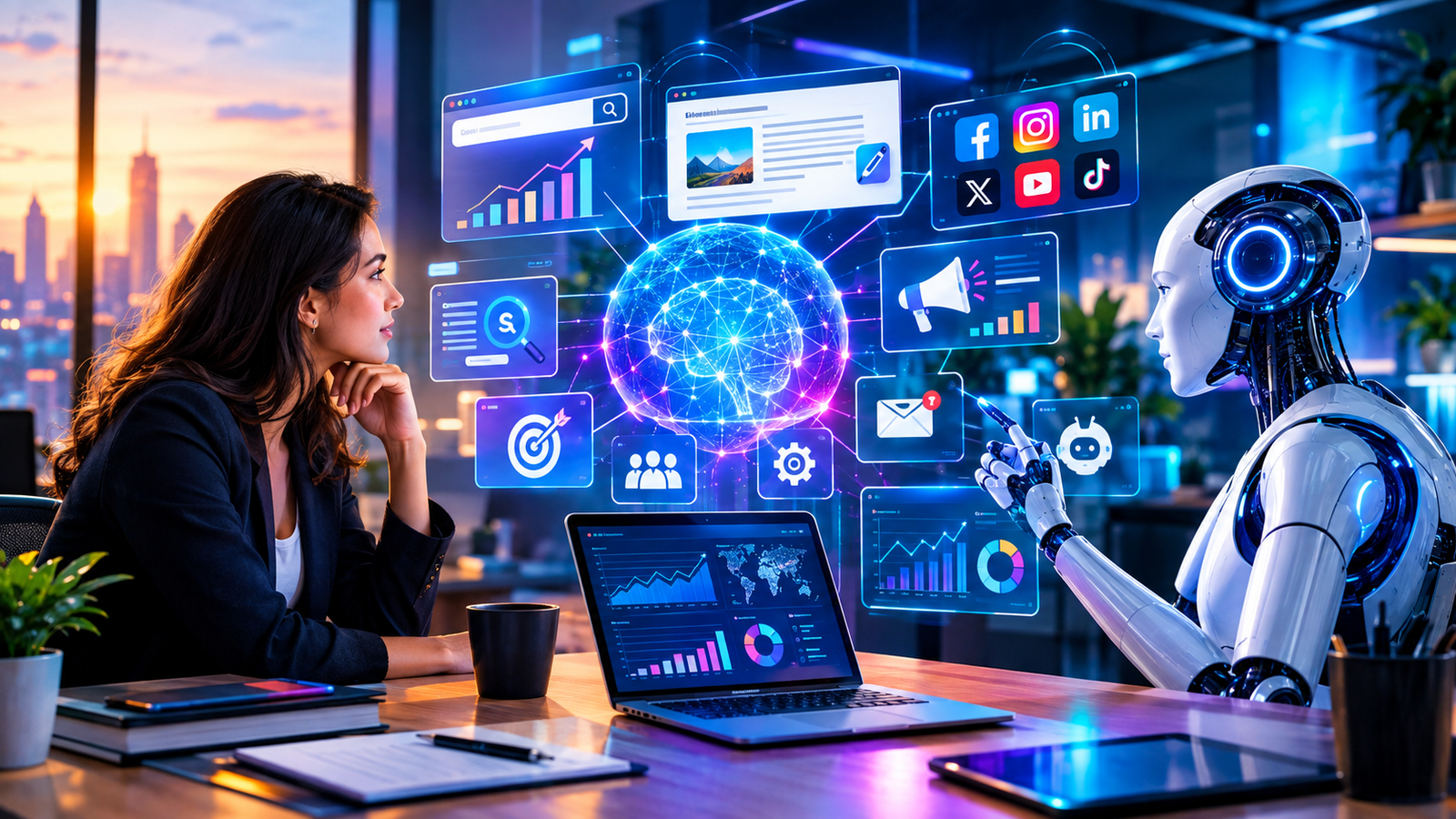
This raises an important question:
Is digital marketing dying because of AI?
The short answer is no.
Digital marketing is not disappearing, but its traditional methods are being transformed. Search engine optimisation, content marketing, social media advertising, email marketing, and paid advertising are all evolving as artificial intelligence becomes part of everyday consumer behaviour.
According to Google’s latest guidance published in 2026, SEO remains fundamentally important for appearing in AI-powered search experiences, including Google AI Overviews and AI Mode. However, Google also emphasises that websites must provide original, valuable, and non-commodity content rather than mass-produced AI material.
The real question is not whether AI will kill digital marketing.
The real question is:
Which digital marketing strategies will survive the AI revolution, and which ones will become obsolete?
Table of Contents
- What Is Happening to Digital Marketing Because of AI?
- Is Digital Marketing Really Dying?
- How AI Is Changing SEO
- The Future of Content Marketing in the AI Era
- AI Search and the Decline of Traditional Website Traffic
- Why Human Creativity Still Matters
- How AI Is Transforming Digital Advertising
- The Rise of AI Marketing Automation
- New Skills Digital Marketers Need in 2026
- What Businesses Should Do to Survive AI Disruption
- Future Predictions for SEO and Digital Marketing
- Research and Data Table
- Frequently Asked Questions
- Final Conclusion
1. What Is Happening to Digital Marketing Because of AI?
Artificial intelligence has entered almost every major area of online marketing.
Businesses now use AI to:
- Generate marketing content.
- Analyze customer behavior.
- Create personalized advertisements.
- Automate email campaigns.
- Predict consumer purchasing decisions.
- Optimize search engine strategies.
- Produce images and videos.
- Answer customer questions through chatbots.
- Monitor competitors and market trends.
Previously, digital marketing required large teams of writers, designers, SEO specialists, analysts, and advertising managers.
Today, a single marketer using AI tools can perform tasks that previously required multiple departments.
This creates both opportunities and challenges.
AI improves productivity, but it also increases competition. When everyone can produce content quickly and cheaply, simply publishing more content no longer guarantees success.
The internet is becoming saturated with similar AI-generated articles.
As a result, originality, trust, expertise, and real human experience are becoming more valuable.
Google’s official 2026 guidance specifically states that creating valuable, unique, people-first content remains important for visibility in generative AI search.
2. Is Digital Marketing Really Dying?
The idea that digital marketing is dying is misleading.
Digital marketing is not disappearing; it is changing its operating system.
Consider previous technological transformations:
- Newspapers did not disappear completely after television.
- Television advertising did not disappear after the internet.
- Traditional websites did not disappear after social media.
- SEO did not disappear after mobile search.
Instead, marketing adapted.
AI is creating another major transformation.
The traditional model looked like this:
Business → Website → Google Search → User Click → Conversion
The emerging AI-powered model increasingly looks like:
Business → Search Engine / AI Assistant → AI Recommendation → User Decision
This changes where consumers discover information.
People may no longer visit ten websites to compare products or services. Instead, they may ask an AI assistant for recommendations and receive a summarized answer.
That means marketers must optimize not only for search engines but also for AI-driven discovery.
This new environment is often called:
- Generative Engine Optimization (GEO)
- Answer Engine Optimization (AEO)
- AI Search Optimization
- Generative Search Marketing
However, Google has warned that marketers should not focus excessively on artificial “AI hacks.” Its official documentation says foundational SEO best practices remain the foundation for visibility in generative search experiences.
3. How AI Is Changing SEO
SEO is one of the digital marketing fields most affected by artificial intelligence.
For more than two decades, SEO professionals focused on:
- Keywords.
- Backlinks.
- Technical optimization.
- Meta descriptions.
- Search rankings.
- Content length.
- Website authority.
These factors still matter, but the way search engines understand content has become significantly more sophisticated.
Google AI Overviews and AI Mode use artificial intelligence to understand user questions, retrieve information, and generate conversational responses.
Google explains that its generative search features rely on core search systems and retrieval technologies to identify relevant and up-to-date information.
Traditional SEO vs AI-Era SEO
| Traditional SEO | AI-Era SEO |
|---|---|
| Keyword targeting | Search intent understanding |
| Ranking for individual queries | Being recognized as a trusted source |
| Backlink quantity | Authority and relevance |
| Content volume | Original and useful content |
| Website traffic | Visibility across search and AI platforms |
| Search snippets | AI-generated recommendations and citations |
| Manual reporting | AI-powered analytics |
The biggest change is that SEO is becoming less about manipulating algorithms and more about building genuine authority.
A website that publishes generic articles using AI may struggle to compete against websites offering:
- Expert opinions.
- Original research.
- First-hand experience.
- Unique data.
- Industry insights.
- Case studies.
- Trusted sources.
This means SEO professionals are not becoming irrelevant.
Their responsibilities are expanding.
4. The Future of Content Marketing in the AI Era
Content marketing is experiencing one of the biggest transformations in its history.
AI can now generate thousands of words in seconds.
But speed is not the same as quality.
The biggest challenge facing content marketers is content duplication.
If 1,000 websites publish nearly identical AI-generated articles about “best digital marketing strategies,” search engines and readers have little reason to prefer one website over another.
This creates a new competitive advantage:
Originality.
The future of content marketing will increasingly reward content that AI cannot easily reproduce.
Examples include:
- Original interviews.
- Personal experiences.
- Industry experiments.
- Original surveys.
- Expert commentary.
- Unique case studies.
- Proprietary data.
- Investigative research.
- Practical tutorials based on real-world experience.
Google’s AI optimization guidance emphasizes the importance of non-commodity content—material that provides value beyond information easily generated or repeated elsewhere.
What AI-Generated Content Can Do Well
AI is excellent at:
- Brainstorming ideas.
- Creating outlines.
- Summarizing research.
- Improving grammar.
- Generating drafts.
- Translating content.
- Creating variations of advertisements.
- Automating repetitive tasks.
What AI Still Struggles With
AI-generated content can struggle with:
- Genuine personal experience.
- Original discoveries.
- Emotional authenticity.
- Complex judgment.
- Contextual understanding.
- Long-term trust.
- Unique brand identity.
The winning strategy is not “AI versus humans.”
It is “AI plus humans.”
5. AI Search and the Decline of Traditional Website Traffic
One of the biggest concerns for publishers and marketers is whether AI-powered search engines will reduce website traffic.
This concern is supported by emerging academic research.
A 2026 preregistered field experiment involving 1,100 participants studied the impact of Google AI Overviews and AI Mode on publisher behavior. Researchers reported that removing AI-generated search features increased click-through rates to publishers, while AI Mode reduced clicks and affected user trust in search information.
Another study examining Wikipedia traffic across more than 161,000 matched article-language pairs estimated that exposure to Google AI Overviews reduced daily traffic to English Wikipedia articles by approximately 15%. The impact was strongest for informational topics where AI summaries could satisfy user intent without requiring a website visit.
These findings suggest that informational websites may face significant traffic challenges.
However, not all content will be affected equally.
Content Most Vulnerable to AI Search
- Simple definitions.
- Basic how-to questions.
- Generic listicles.
- Common factual explanations.
- Commodity product descriptions.
- Repetitive informational articles.
Content More Resistant to AI Substitution
- Original research.
- Product demonstrations.
- First-hand reviews.
- Complex professional advice.
- Interactive tools.
- Community discussions.
- Unique databases.
- Original journalism.
- Strong brand communities.
This creates a major opportunity for businesses willing to invest in distinctive content.
6. Why Human Creativity Still Matters
Artificial intelligence can imitate language, but imitation is not the same as human creativity.
Successful marketing depends on understanding people.
Consumers do not purchase products only because of keywords or advertisements. They buy because of emotions, trust, identity, convenience, relationships, and perceived value.
Human creativity remains essential in areas such as:
Brand Storytelling
People connect with stories, experiences, and authentic personalities.
Emotional Marketing
AI can analyze emotional language, but human marketers understand cultural context and emotional nuance differently.
Strategic Thinking
Marketing decisions often involve uncertainty, competition, timing, and long-term positioning.
Community Building
Strong communities depend on human relationships and shared experiences.
Trust
Consumers increasingly want transparent and authentic communication.
AI can assist marketers with all these activities, but replacing human judgment completely creates risks.
The future of marketing belongs to professionals who combine technological efficiency with human understanding.
7. How AI Is Transforming Digital Advertising
Paid advertising is another area experiencing rapid transformation.
Platforms such as Google, Meta, TikTok, and other advertising networks increasingly use machine learning to automate:
- Audience targeting.
- Budget allocation.
- Creative testing.
- Conversion prediction.
- Ad placement.
- Campaign optimization.
Instead of manually selecting every audience segment, marketers can increasingly provide campaign objectives and allow AI systems to optimize delivery.
This changes the role of advertising professionals.
Previously, marketers focused heavily on campaign settings.
Now, they increasingly focus on:
- Creative strategy.
- Brand positioning.
- Offer development.
- Customer insights.
- Data quality.
- Conversion optimization.
AI advertising can improve efficiency, but it also creates concerns about transparency and control.
Businesses may become dependent on advertising algorithms they do not fully understand.
Therefore, marketers need to maintain independent measurement systems and business intelligence.
8. The Rise of AI Marketing Automation
Marketing automation is becoming one of the strongest growth areas in digital marketing.
AI-powered tools can automate customer journeys across multiple channels.
For example:
- A customer visits a website.
- AI analyzes browsing behavior.
- The system predicts customer interests.
- A personalized email is sent.
- The customer receives targeted recommendations.
- AI chatbots answer questions.
- The system predicts the likelihood of purchase.
This creates more personalized marketing experiences.
However, automation must be balanced with privacy and transparency.
Poor-quality data can lead to incorrect personalization.
Research and industry reports increasingly emphasize that AI adoption alone does not guarantee marketing success. Organizations need high-quality customer data, clear strategy, and skilled teams.
A 2026 Salesforce-related marketing report cited by Indian technology media reported widespread AI adoption among marketers, while also highlighting challenges related to data quality, technical expertise, and regulatory concerns.
The lesson is simple:
AI is only as effective as the data and strategy behind it.
9. New Skills Digital Marketers Need in 2026
The digital marketer of the future will need a combination of technical, creative, and analytical skills.
1. AI Literacy
Marketers should understand how generative AI, machine learning, and AI search systems work.
2. SEO and Search Intent
Understanding search behaviour remains essential even as search engines become conversational.
3. Data Analysis
Marketers need to interpret analytics, conversion data, customer behaviour, and campaign performance.
4. Content Strategy
The ability to create original, authoritative, and useful content will become increasingly valuable.
5. Brand Building
Strong brands can reduce dependence on search algorithms.
6. Critical Thinking
AI-generated information must be verified and evaluated carefully.
7. Automation Management
Professionals should know how to integrate AI tools into marketing workflows.
8. Customer Psychology
Understanding why people make decisions remains one of the most valuable marketing skills.
The marketer who only knows how to write keywords may struggle.
The marketer who understands people, technology, data, and strategy will remain highly valuable.
10. What Businesses Should Do to Survive AI Disruption
Businesses should not respond to AI disruption by abandoning SEO or content marketing.
Instead, they should evolve their strategy.
Build Original Content
Create content based on experience, research, expertise, and unique insights.
Optimize for Humans First
Write for people rather than attempting to manipulate AI systems.
Strengthen Brand Authority
Develop recognizable brands that customers actively search for.
Diversify Traffic Sources
Do not depend entirely on Google organic traffic.
Explore:
- Email marketing.
- Social media.
- YouTube.
- Podcasts.
- Communities.
- Direct traffic.
- Partnerships.
Use AI Strategically
AI should improve productivity without replacing quality control.
Monitor Search Changes
Track changes in:
- Organic rankings.
- AI Overview visibility.
- Referral traffic.
- Conversion rates.
- Brand mentions.
- Customer behaviour.
Google recommends continuing foundational SEO practices and monitoring performance through Search Console as generative search evolves.
11. Future Predictions for SEO and Digital Marketing
The next five years will likely bring major changes to online marketing.
Prediction 1: Search Will Become More Conversational
Users will increasingly ask complex questions instead of typing short keywords.
Prediction 2: Website Traffic Will Become More Valuable
As AI answers satisfy simple questions, visitors reaching websites may have stronger purchase intent.
Prediction 3: Original Content Will Gain Importance
Generic AI-generated content will become less competitive.
Prediction 4: Brand Authority Will Matter More
Consumers may increasingly ask AI assistants which brands they trust.
Prediction 5: SEO Professionals Will Become AI Visibility Strategists
SEO will expand beyond rankings into visibility across multiple AI platforms.
Prediction 6: Marketing Automation Will Become Standard
Small businesses will gain access to sophisticated marketing capabilities previously available only to large companies.
Prediction 7: Human Creativity Will Become a Competitive Advantage
As AI-generated content becomes common, authenticity will become more valuable.
12. AI and Digital Marketing Research Data Table
| Research Area & Source | Key Finding |
|---|---|
| Google AI Search — Google Search Central, 2026 | Foundational SEO remains relevant for Google AI Overviews and AI Mode. |
| Content Quality — Google Search Central | Google emphasizes unique, valuable, original, and non-commodity content. |
| Publisher Traffic — 2026 Academic Field Experiment | AI-powered search experiences can reduce click-through rates to publisher websites. |
| Wikipedia Traffic — Academic Research, 2026 | One study associated Google AI Overview exposure with approximately 15% lower daily traffic to English Wikipedia articles. |
| AI Search Behavior — Multiple Academic Studies | AI-generated summaries are changing how users discover and interact with websites. |
| Content Marketing Investment — Clutch and Conductor Report | 87% of surveyed content marketers planned to increase their content marketing budgets in 2026. |
| AI Marketing Adoption — Industry Marketing Reports | Major global marketing organizations are increasing their adoption of artificial intelligence tools. |
| SEO Strategy — Google Search Central | Traditional SEO fundamentals remain important despite the growth of AI-powered search. |
Conclusion: The available research suggests that digital marketing is undergoing a structural transformation rather than disappearing.
13. Frequently Asked Questions
Is digital marketing dying because of AI?
No. Digital marketing is evolving because of AI. Traditional methods such as keyword-focused content and manual advertising management are changing, but marketing remains essential for businesses.
Will AI replace SEO professionals?
AI may automate repetitive SEO tasks, but strategic SEO, technical expertise, content quality, brand authority, and data analysis will remain valuable.
Will AI-generated content rank on Google?
AI-generated content can appear in Google Search if it provides value and follows Google’s policies. However, mass-produced content without originality or usefulness may violate Google’s spam policies.
Google evaluates content based on quality and usefulness rather than simply whether AI was used to create it.
Is SEO still important in 2026?
Yes. Google officially states that foundational SEO remains relevant for traditional Search and generative AI search features.
What is the future of content marketing?
The future of content marketing will focus more on originality, expertise, first-hand experience, research, and strong brand identity.
Will AI reduce website traffic?
For some types of informational content, research suggests AI-generated search answers can reduce clicks to publishers. However, original, commercial, community-driven, and experience-based content may remain highly valuable.
Should businesses stop investing in SEO?
No. Businesses should continue investing in SEO while diversifying traffic sources and adapting content strategies for AI-powered search.
What skills should digital marketers learn?
Important skills include AI literacy, SEO, data analysis, content strategy, automation, customer psychology, and strategic marketing.
14. Final Conclusion: Is Digital Marketing Dying Because of AI?
Digital marketing is not dying.
It is entering its most significant transformation since the arrival of search engines and social media.
Artificial intelligence is changing how people search, how businesses advertise, how content is created, and how brands connect with customers.
Some traditional marketing tasks will disappear.
Some SEO strategies will become less effective.
Generic content production will face increasing competition.
But the fundamental purpose of marketing remains unchanged:
Understanding people and delivering valuable solutions.
AI can generate content, analyze data, automate campaigns, and improve efficiency. However, businesses still need creativity, trust, expertise, strategy, and human connection.
The future belongs neither entirely to humans nor entirely to machines.
It belongs to marketers who understand how to combine both.
The most successful digital marketers in the AI era will not ask, “How can I replace marketing with AI?”
They will ask:
“How can I use AI to become a better marketer while creating more valuable experiences for real people?”
That is the future of digital marketing.