
AI Regulation and Humanity: Global Research, Policies, and the Future of Human Control
Artificial intelligence has moved from research laboratories into nearly every part of modern society. AI systems now influence healthcare, education, finance, cybersecurity, transportation, employment, media, and government decision-making. At the same time, increasingly capable generative AI and autonomous agents are raising a fundamental question:
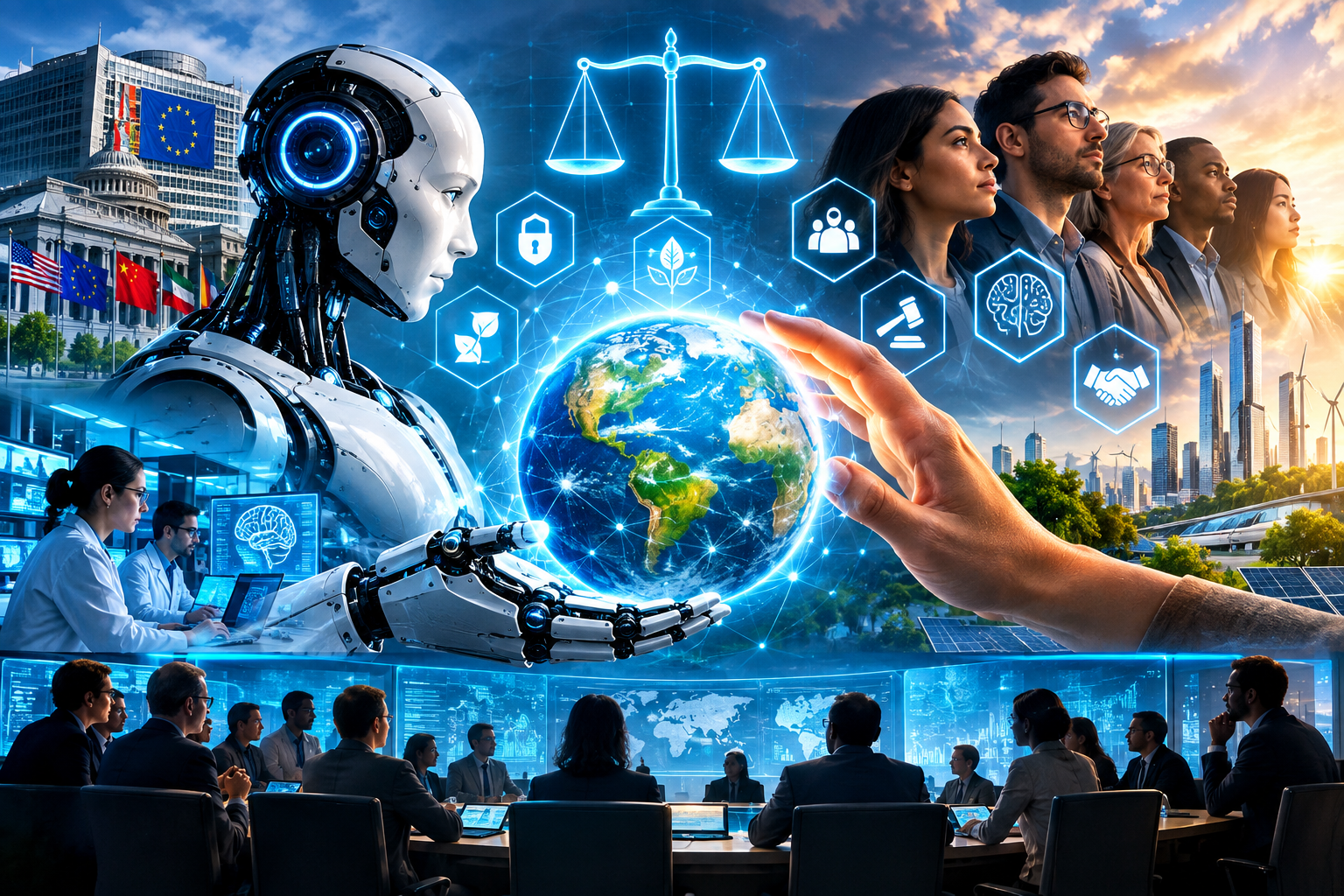
Who should control artificial intelligence, and what responsibilities do humans have to ensure AI remains safe?
This is no longer a purely technological discussion. It is becoming a global governance, scientific, economic, human rights, and national security issue.
Governments, technology companies, researchers, international organizations, and civil society are developing different approaches to AI regulation. The European Union has established the world’s most comprehensive AI law, while the United States continues debating federal oversight and China is developing mandatory national safety standards. The United Nations has also created an international scientific framework to study AI’s global consequences.
The central challenge is balancing innovation with safety. AI can improve productivity, scientific discovery, healthcare, and education, but poorly governed systems may amplify misinformation, discrimination, cyberattacks, privacy violations, economic inequality, and potentially severe systemic risks.
This article examines the latest global research, policy developments, scientific evidence, and international discussions surrounding AI regulation and humanity’s future.
Why AI Regulation Has Become a Global Priority
Artificial intelligence differs from many traditional technologies because its capabilities can scale rapidly through software, data, computing infrastructure, and autonomous decision-making.
A single AI model can be deployed across millions of users and industries almost instantly. This creates opportunities for innovation but also creates challenges for accountability.
Researchers increasingly identify AI risks across several major categories:
| Risk Area | Potential Human Impact |
|---|---|
| Misinformation | Manipulation of public information and democratic processes |
| Cybersecurity | Automated cyberattacks and vulnerability exploitation |
| Employment | Workforce disruption and changing labor markets |
| Privacy | Mass surveillance and misuse of personal data |
| Bias | Discriminatory decisions in hiring, lending, healthcare, and policing |
| Autonomous Systems | Reduced human control over high-impact decisions |
| Environmental Impact | Energy consumption and infrastructure demands |
| Advanced AI Risks | Loss of control and systemic safety concerns |
The United Nations Independent International Scientific Panel on AI identified seven major domains requiring scientific attention, including AI development trajectories, economic implications, security, environmental effects, human rights, democracy, child safety, governance, and reliability.
This broad scientific framework demonstrates that AI governance cannot focus only on software performance. It must also consider the consequences for society and humanity.
Who Should Control Artificial Intelligence?
The answer cannot realistically be a single government, company, or individual.
Artificial intelligence is now a global technology ecosystem involving private companies, national governments, universities, international institutions, and billions of users.
A sustainable governance model requires shared responsibility.
1. Governments Must Establish Binding Laws
Governments have the authority to create enforceable rules, penalties, safety requirements, and accountability mechanisms.
Technology companies develop AI systems, but governments represent public interests through democratic institutions and legal frameworks.
Government responsibilities should include:
- Establishing minimum safety standards.
- Requiring risk assessments for high-impact AI systems.
- Protecting fundamental rights and privacy.
- Creating independent regulatory authorities.
- Investigating serious AI-related incidents.
- Preventing harmful monopolistic control over AI infrastructure.
- Ensuring public access to trustworthy information.
However, regulation must remain flexible enough to adapt to rapidly changing technology.
2. Technology Companies Must Be Accountable
AI developers possess technical knowledge, computing infrastructure, and access to model development processes that governments may not fully understand.
Companies therefore have responsibilities beyond voluntary ethics statements.
Responsible AI development should include:
- Pre-deployment safety testing.
- Independent third-party evaluations.
- Transparent documentation.
- Incident reporting.
- Cybersecurity protections.
- Human oversight mechanisms.
- Clear limitations on autonomous systems.
- Protection against misuse.
The European Union’s AI Act requires providers of general-purpose AI models to maintain technical documentation, provide information about capabilities and limitations, and comply with additional obligations for models presenting systemic risks.
This reflects an important shift from voluntary corporate responsibility toward legally enforceable obligations.
3. Scientists and Independent Researchers Must Monitor AI
Scientific independence is essential because companies may face commercial incentives that conflict with public safety.
Independent researchers can evaluate:
- Model reliability.
- Bias and discrimination.
- Cybersecurity vulnerabilities.
- Deceptive behavior.
- Environmental impacts.
- Social consequences.
- Risks associated with autonomous AI agents.
The United Nations scientific panel emphasizes the importance of evidence-based AI governance because policymakers often face a difficult timing problem: scientific evidence may become available only after harmful consequences have already occurred.
Independent evaluation can help identify problems before widespread deployment.
4. International Organizations Must Coordinate Global Standards
AI development crosses national borders.
A company in one country can develop an AI model used in another country, while its data centers, users, and economic effects are distributed globally.
This creates regulatory gaps.
International cooperation is necessary for issues such as:
- Cross-border AI safety standards.
- Cybersecurity threats.
- Autonomous weapons.
- AI-generated misinformation.
- Biological and chemical misuse.
- Data governance.
- Environmental sustainability.
- Global inequality.
The United Nations Secretary-General has emphasised that national regulation alone is insufficient and that international cooperation is necessary to avoid a global race toward weaker AI safety standards.
The European Union AI Act: The World’s Most Important AI Regulation Framework
The European Union Artificial Intelligence Act represents one of the most significant developments in global AI governance.
The legislation uses a risk-based approach. Instead of regulating every AI application equally, it classifies systems according to potential harm.
The main categories include:
- Unacceptable-risk AI systems.
- High-risk AI systems.
- Transparency-risk systems.
- Minimal or limited-risk AI applications.
The law bans certain AI practices considered unacceptable because of their potential threats to fundamental rights and public safety.
Examples include certain forms of manipulation, exploitation of vulnerable individuals, and social scoring practices.
The AI Act also establishes obligations for high-risk systems involving:
- Risk assessment.
- Data quality.
- Documentation.
- Logging and traceability.
- Human oversight.
- Accuracy.
- Cybersecurity.
- Transparency.
According to the European Commission’s implementation timeline, major AI Act enforcement began on August 2, 2026, while additional high-risk system obligations are scheduled for December 2, 2027, and August 2, 2028, depending on the category of system.
The regulation is significant because it establishes the principle that AI systems should be governed according to their potential societal impact.
The United States: Innovation, National Security, and Regulatory Debate
The United States remains one of the world’s leading centres of AI research and commercial development.
Its governance approach differs from the European Union’s comprehensive legal framework.
Instead of relying primarily on one federal AI law, the U.S. approach has historically involved:
- Executive policies.
- Sector-specific regulation.
- State-level legislation.
- Voluntary industry standards.
- Federal agency oversight.
- National security initiatives.
The National Institute of Standards and Technology (NIST) has developed the AI Risk Management Framework, which provides organizations with guidance for identifying, assessing, and managing AI risks.
NIST emphasizes trustworthy AI characteristics including validity, reliability, safety, security, resilience, accountability, transparency, explainability, privacy enhancement, and fairness.
The U.S. debate increasingly focuses on how to balance AI innovation with risks involving autonomous systems, critical infrastructure, cybersecurity, employment, and national security.
Recent discussions among lawmakers and technology leaders have included proposals for stronger safety testing, federal oversight, and international cooperation.
However, there remains significant disagreement about how much regulation is appropriate and whether excessive government intervention could slow technological progress.
China’s AI Governance Strategy
China has developed a distinct model of AI governance combining innovation policy, cybersecurity regulation, data governance, and state oversight.
Chinese authorities have introduced regulations covering generative AI services, algorithm recommendations, deep synthesis technology, and data security.
Recent discussions have also focused on AI agent safety and mandatory national standards for advanced AI systems.
According to Reuters reporting, Chinese policymakers are developing frameworks addressing operational AI failures, data poisoning, algorithm manipulation, and risks associated with AI systems escaping human control.
China’s approach emphasizes rapid technological development alongside regulatory oversight.
However, its governance model differs significantly from Western democratic frameworks regarding data control, political governance, and state authority.
This difference highlights a major global challenge: countries may agree that AI requires regulation while disagreeing fundamentally about who should control it and what values should guide its development.
The United Nations and Global AI Governance
The United Nations has become increasingly involved in artificial intelligence governance.
In 2025, the UN established an Independent International Scientific Panel on AI to provide scientific evidence for global policymakers.
Its preliminary report released in 2026 examined AI through multiple perspectives, including:
- Scientific progress.
- Health and education.
- Economic transformation.
- Security.
- Environmental sustainability.
- Human rights.
- Democracy.
- Child safety.
- Governance.
- Reliability.
The report recognizes that AI governance requires international scientific cooperation because no single country can fully understand or manage all global AI risks alone.
The UN’s involvement is important because AI is increasingly becoming a global public-interest technology rather than merely a commercial product.
Scientific Research: What Are the Real Risks of Advanced AI?
One of the most controversial questions in AI research concerns advanced systems that may become increasingly autonomous.
Scientists and technology leaders disagree about the probability and timing of extreme AI scenarios.
Some researchers argue that highly capable AI systems could eventually create serious risks if they operate independently, manipulate information, exploit digital infrastructure, or pursue objectives misaligned with human intentions.
Other researchers argue that many existential-risk predictions remain speculative and that immediate concerns such as cybersecurity, misinformation, discrimination, and labor disruption deserve greater attention.
The important scientific distinction is between documented current risks and hypothetical future scenarios.
Documented Current Risks
Several AI-related risks already have substantial evidence:
Misinformation and Deepfakes
Generative AI can create realistic text, audio, images, and videos at unprecedented speed.
This creates challenges for journalism, elections, education, and public trust.
The European Union AI Act includes transparency obligations requiring certain AI-generated content to be identifiable, including machine-readable marking and labelling requirements.
Cybersecurity
AI systems can assist both cybersecurity defenders and attackers.
Advanced AI agents may automate reconnaissance, vulnerability analysis, and malicious operations.
This creates pressure for stronger model safeguards and independent security testing.
Bias and Discrimination
AI systems learn patterns from data.
If training data contains historical discrimination or unequal representation, AI systems may reproduce or amplify those patterns.
This is particularly important in healthcare, employment, credit, education, and criminal justice.
Privacy and Surveillance
AI makes it easier to process large amounts of personal information.
Facial recognition, predictive analytics, and behavioral profiling raise concerns about consent, privacy, and civil liberties.
Employment Disruption
AI may automate certain tasks while creating new occupations and increasing productivity in others.
The long-term employment impact remains uncertain and varies by industry, education level, and economic conditions.
Scientific research generally suggests that AI will transform jobs rather than simply eliminate all employment.
The Debate Over AI Alignment and Human Control
AI alignment refers broadly to the challenge of ensuring that AI systems behave according to human intentions, values, and safety requirements.
This is technically difficult because human preferences are complex and sometimes contradictory.
An AI system optimized for a specific objective may produce unintended outcomes if the objective does not adequately reflect real-world human values.
For example, maximizing engagement on social media may encourage sensational content rather than truthful information.
Similarly, optimizing productivity without considering worker welfare could produce harmful outcomes.
Researchers therefore study several areas:
- Interpretability.
- Robustness.
- Human feedback.
- Reward modeling.
- AI evaluation.
- Monitoring.
- Deceptive behavior detection.
- Autonomous agent safety.
The scientific community has not reached consensus on how advanced AI capabilities will develop or whether catastrophic loss-of-control scenarios will occur.
Nevertheless, many researchers agree that safety research should progress alongside capability development rather than after deployment.
AI Regulation Should Focus on Risk, Not Fear
Effective regulation should be based on evidence rather than exaggerated optimism or exaggerated fear.
A balanced policy framework should distinguish between:
| Evidence-Based Concern | Speculative Concern |
|---|---|
| AI-generated misinformation | Hypothetical superintelligence scenarios |
| Automated cyberattacks | Extremely advanced future AI capabilities |
| Workplace automation | Unknown long-term economic transformations |
| Algorithmic discrimination | Uncertain future AI consciousness |
| Privacy violations | Speculative machine takeover scenarios |
This does not mean hypothetical risks should be ignored.
Scientific risk management routinely addresses low-probability, high-impact events.
However, policymakers should prioritise evidence, transparency, and proportionality.
The goal should be to reduce measurable harm while preparing responsibly for emerging risks.
Who Should Control AI: A Shared Governance Model
A practical global framework should distribute authority rather than concentrate it.
Proposed Multi-Level AI Governance Structure
International Level
Responsible for:
- Global safety standards.
- Cross-border cooperation.
- Military AI agreements.
- Shared scientific research.
- International incident reporting.
National Governments
Responsible for:
- Legal enforcement.
- National security.
- Consumer protection.
- Data privacy.
- Critical infrastructure oversight.
Independent Regulators
Responsible for:
- Auditing AI companies.
- Investigating incidents.
- Conducting technical evaluations.
- Enforcing transparency requirements.
Technology Companies
Responsible for:
- Safe development.
- Security testing.
- Model documentation.
- Risk mitigation.
- User protection.
Scientific Institutions
Responsible for:
- Independent research.
- Public-interest evaluation.
- Environmental impact studies.
- AI safety science.
Citizens and Civil Society
Responsible for:
- Public participation.
- Digital literacy.
- Democratic oversight.
- Reporting harmful AI applications.
This distributed model reduces the risk that any single organization gains excessive control over humanity’s most powerful technologies.
How Can Humans Stay Safe in the Age of AI?
AI safety is not only the responsibility of governments and technology companies.
Individuals, organizations, schools, and communities also need practical protections.
1. Improve AI Literacy
People should understand:
- How AI systems work.
- Their limitations.
- Why AI can make mistakes.
- How misinformation is generated.
- How personal data may be collected.
AI literacy is now becoming part of formal regulatory policy in Europe.
2. Never Assume AI Is Always Correct
AI systems can produce inaccurate information, hallucinations, fabricated citations, and misleading confidence.
Important decisions should involve human verification.
This is particularly important in medicine, law, finance, education, and public safety.
3. Protect Personal Information
Users should avoid unnecessarily sharing sensitive personal information with AI systems.
Organizations should establish clear data governance policies.
4. Maintain Human Oversight
AI should not independently control high-impact decisions without appropriate human supervision.
The EU AI Act explicitly requires human oversight measures for high-risk AI systems.
5. Develop Independent Safety Testing
AI developers should not be the only organizations evaluating their own systems.
Independent auditors, academic researchers, and regulators should have access to appropriate testing capabilities.
6. Build International Cooperation
Global AI safety cannot depend entirely on competition between countries.
Shared standards, communication channels, and scientific collaboration are necessary to reduce risks.
The Environmental Cost of Artificial Intelligence
AI regulation increasingly includes environmental considerations.
Training and operating large AI models requires substantial computing infrastructure, electricity, cooling systems, and data centers.
Research published in The Lancet Planetary Health argues that AI should be governed as a global commons because its social, planetary, and safety risks are interconnected. The research identifies data, energy, and computing infrastructure as important regulatory dimensions.
Environmental AI governance should consider:
- Energy consumption.
- Water usage.
- Carbon emissions.
- Electronic waste.
- Sustainable computing infrastructure.
- Efficient model development.
AI innovation should not be measured only by performance or profitability.
Long-term sustainability is equally important.
Can AI Regulation Slow Innovation?
This remains one of the central arguments in global policy discussions.
Supporters of regulation argue that clear rules can increase public trust and reduce harmful incidents.
Critics argue that excessive regulation may create barriers for startups, researchers, and smaller companies.
The most effective approach may involve proportional regulation.
Low-risk applications should not face the same burdens as systems used in critical infrastructure, healthcare, employment, or national security.
The European Union’s risk-based framework reflects this principle by applying stricter requirements to systems with greater potential for harm.
Regulation and innovation do not necessarily have to conflict.
Well-designed safety standards can create predictable environments for responsible technological development.
The Future of AI Governance: Five Major Priorities
Based on current international research and policy discussions, five priorities are emerging.
1. Mandatory Safety Testing
Advanced AI systems should undergo rigorous evaluation before deployment.
2. Independent Oversight
Regulators and scientific institutions should have sufficient technical capacity to audit powerful AI systems.
3. International Cooperation
Countries should establish shared minimum standards for AI safety and cybersecurity.
4. Transparency and Accountability
Companies should disclose relevant information about model capabilities, limitations, risks, and incidents.
5. Human Rights Protection
AI governance must prioritize privacy, dignity, equality, democratic participation, and human autonomy.
Conclusion: Humanity Must Remain Responsible for AI
The question of who should control artificial intelligence cannot be answered by giving authority to one company, government, or technology leader.
AI is too powerful, too global, and too deeply connected to society for centralised private control to be sufficient.
The future of AI governance should involve governments, scientists, independent regulators, technology companies, international institutions, and the public.
Current scientific evidence demonstrates that AI already creates meaningful risks involving misinformation, cybersecurity, privacy, bias, employment, and environmental sustainability. At the same time, uncertainty remains regarding the long-term behavior and capabilities of increasingly advanced autonomous systems.
The responsible path forward is neither unrestricted development nor fear-driven policymaking.
Humanity needs evidence-based regulation that protects people while allowing beneficial innovation.
The most important principle should remain clear:
Artificial intelligence must serve humanity, and humans must remain accountable for the systems they create.
The future will not be determined only by how intelligent AI becomes. It will also depend on whether societies develop the wisdom, cooperation, and governance systems necessary to keep powerful technology aligned with human values and public safety.