
Will AI Take Our Jobs? Understanding the Future of Work.
Artificial intelligence (AI) is no longer a futuristic concept confined to science fiction. From ChatGPT and AI-powered software to autonomous robots and intelligent business systems, artificial intelligence is rapidly transforming how people work, learn, communicate, and earn money.
But one question continues to dominate global discussions:
Will AI take our jobs, or will it create a new era of opportunity?
The answer is more complex than a simple yes or no. According to recent research from the International Labour Organization (ILO), artificial intelligence is more likely to transform many jobs than completely eliminate them. However, certain occupations, particularly those involving repetitive and predictable tasks, face greater exposure to automation.
The future of work will depend not only on what AI can do, but also on how businesses, governments, educators, and workers adapt to its growing capabilities.
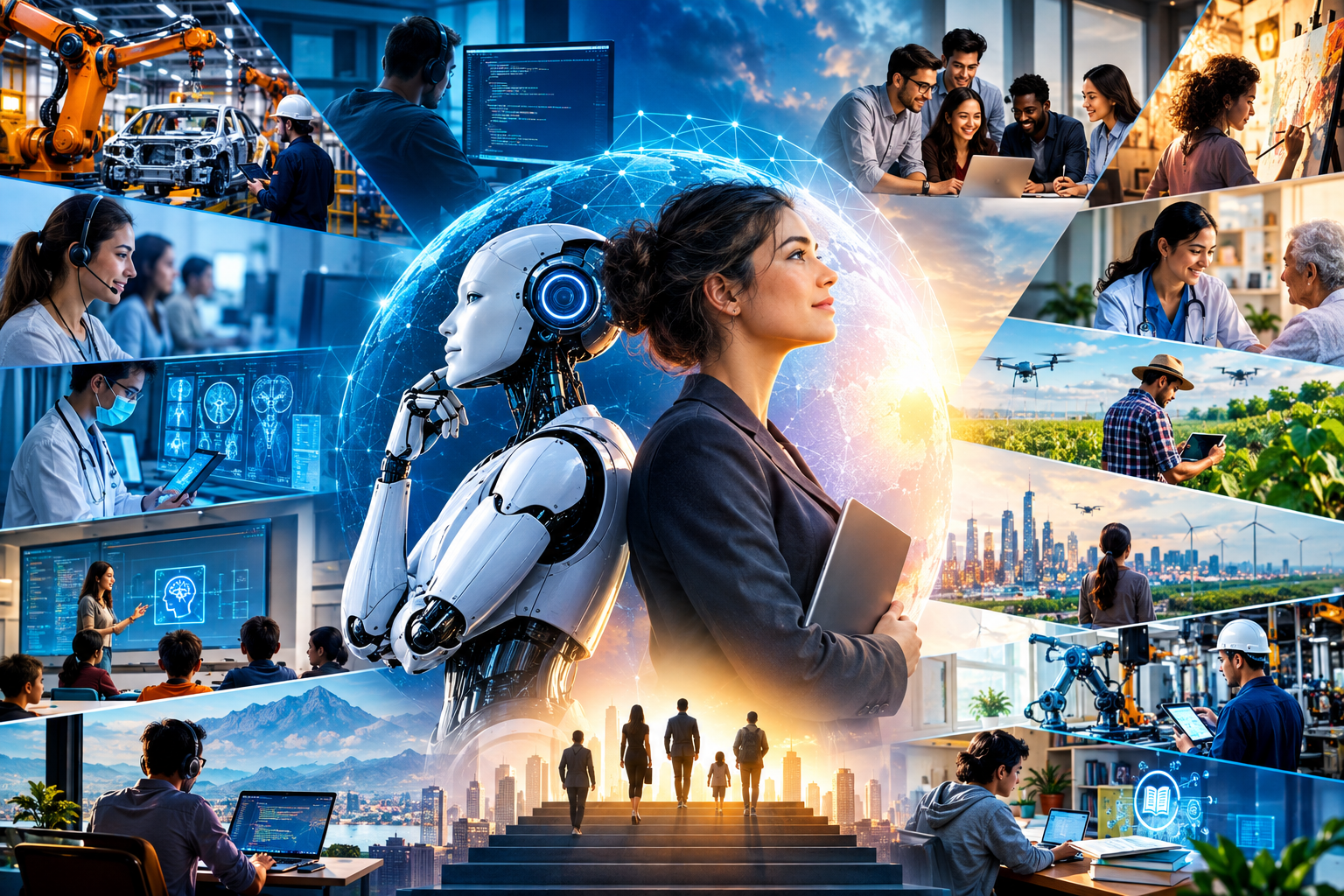
The Current State of AI and Employment
Recent global research presents a mixed picture of AI’s impact on employment.
The ILO’s 2026 research review on generative AI found that productivity gains are real but uneven, while large-scale job displacement remains limited so far. The organization also highlighted concerns about inequality, declining opportunities for younger workers, and changes in workplace organisation.
PwC’s 2026 Global AI Jobs Barometer analysed more than one billion job advertisements across six continents. Its findings suggest that companies most exposed to AI are experiencing significantly faster productivity growth, while demand for advanced human skills such as leadership, judgment, and decision-making is increasing.
This evidence suggests that AI is not simply replacing humans. Instead, it is changing the tasks humans perform and the skills employers value.
20 Ways Artificial Intelligence Is Transforming the Future of Work
1. Automation of Repetitive Tasks
AI can automate repetitive administrative tasks such as data entry, scheduling, document processing, and basic customer support.
This allows employees to spend more time on creative, strategic, and interpersonal responsibilities.
However, workers whose jobs primarily consist of predictable tasks may experience greater pressure to reskill.
2. Transformation of Office Jobs
White-collar professions are increasingly affected by generative AI.
Writing, accounting, programming, legal research, marketing, and customer service now use AI tools to improve speed and efficiency.
Rather than eliminating every office job, AI is changing how professionals complete their daily responsibilities.
3. Creation of New AI Careers
Artificial intelligence is also creating entirely new employment opportunities.
Emerging roles include:
- AI engineers
- Machine learning specialists
- Prompt engineers
- AI trainers
- Data scientists
- AI ethics researchers
- Robotics technicians
- AI product managers
- Automation consultants
As AI adoption expands, demand for workers who can build, manage, and responsibly use these technologies is expected to grow.
4. AI Is Increasing Worker Productivity
One of the strongest arguments in favor of AI is its ability to help people accomplish more in less time.
Employees can use AI to summarize documents, analyze information, generate ideas, write software code, and automate workflows.
PwC’s research found productivity growth at companies highly exposed to AI was 40% higher than at companies with lower exposure.
The productivity benefits, however, depend on effective implementation, worker training, and organizational changes.
5. Changes in Required Skills
The future workforce will require a combination of technical and human skills.
Employers increasingly value:
- Critical thinking
- Problem-solving
- Communication
- Leadership
- Creativity
- Emotional intelligence
- Digital literacy
- AI literacy
PwC reports that skills in AI-exposed occupations are changing more than twice as quickly as skills in less-exposed occupations.
This means lifelong learning will become increasingly important.
6. AI and the Future of Software Development
Software developers are among the professions experiencing significant changes from AI coding tools.
AI assistants can generate code, identify bugs, write documentation, and automate repetitive programming tasks.
However, human developers remain important for architecture, system design, security, project management, and understanding complex business requirements.
The role of programmers may evolve from writing every line of code to supervising intelligent development systems.
7. Transformation of Customer Service
AI-powered chatbots and virtual assistants are changing customer support.
Companies can now provide 24-hour assistance for common questions and routine transactions.
Human customer service workers will increasingly focus on complex problems, emotional situations, and cases requiring judgment.
8. AI in Healthcare and Medicine
Artificial intelligence is transforming healthcare through medical imaging, drug discovery, diagnostics, and administrative automation.
AI can help doctors identify patterns in large amounts of medical data.
However, healthcare professionals remain essential because medicine involves human trust, ethical responsibility, physical care, and complex decision-making.
AI is likely to assist medical workers rather than replace the entire healthcare workforce.
9. AI and Education
Teachers and educators are using AI to personalize learning, generate educational materials, and provide tutoring assistance.
AI can help students receive immediate feedback and support.
Nevertheless, teachers play an important role in motivation, mentorship, emotional development, and social learning.
The classroom of the future may combine human teachers with intelligent educational assistants.
10. Growth of Remote and Digital Work
AI enables businesses to operate more efficiently across geographical boundaries.
Remote teams can use AI-powered collaboration tools, translation systems, project management software, and automated communication platforms.
This creates opportunities for international freelancers and digital professionals.
At the same time, competition may increase because businesses can access talent from around the world.
11. Pressure on Entry-Level Jobs
One of the biggest concerns surrounding AI is its impact on young workers entering the labor market.
Many entry-level positions involve repetitive tasks that AI can perform efficiently.
The ILO has warned that generative AI may affect employment opportunities for younger workers and contribute to workplace inequality.
Companies and educational institutions may need to redesign internships, training programs, and early-career pathways.
12. AI and the Gig Economy
Freelancers working in writing, graphic design, translation, and basic programming are already experiencing changes due to generative AI.
Academic research published in 2023 found that online labor markets experienced declines in demand and transactions for some text-related and programming-related services following the introduction of ChatGPT.
However, the remaining opportunities increasingly require specialized knowledge, creativity, and complex problem-solving.
13. Expansion of Human-AI Collaboration,
The most likely future workplace model is collaboration between humans and machines.
AI can process information quickly, while humans contribute judgment, empathy, creativity, and accountability.
For example, an AI system may analyse thousands of documents, but a human manager decides how to apply the findings.
This combination can improve decision-making without removing human responsibility.
14. Transformation of Manufacturing
Robotics and AI-powered automation are changing factories and production systems.
Machines can inspect products, optimize supply chains, predict equipment failures, and perform dangerous tasks.
At the same time, new technical roles are emerging in robotics maintenance, industrial AI, engineering, and system supervision.
Manufacturing employment may change significantly, but automation does not necessarily eliminate every industrial opportunity.
15. AI and Small Businesses
Artificial intelligence is making advanced business capabilities accessible to small companies.
Entrepreneurs can use AI for:
- Marketing campaigns
- Customer support
- Financial analysis
- Website development
- Market research
- Content creation
- Inventory management
This lowers some barriers to entrepreneurship and allows small businesses to compete with larger organizations.
16. Changing Workplace Inequality
AI can increase productivity and create opportunities, but its benefits may not be distributed equally.
Workers with advanced digital skills may experience higher demand and wages, while workers in highly automatable roles may face wage pressure or job insecurity.
The ILO emphasizes that AI’s impact depends heavily on how organizations introduce the technology and whether workers receive protection and opportunities for retraining.
17. AI Is Changing Leadership and Management
Managers are increasingly responsible for integrating AI into workplace operations.
Future leaders will need to understand both technology and people.
They must decide:
- Which tasks should be automated?
- How should AI decisions be reviewed?
- What training do employees need?
- How can privacy and fairness be protected?
Leadership skills will remain important even as automation increases.
18. Demand for AI Literacy Will Become Essential
AI literacy may become as important as basic computer literacy.
Employees will need to understand how AI systems work, their limitations, and how to use them responsibly.
Knowing how to ask effective questions, verify AI-generated information, and protect sensitive data will become valuable workplace skills.
19. New Opportunities in Developing Economies
Artificial intelligence may provide significant opportunities for developing countries.
According to recent World Bank reporting, emerging economies could benefit from AI through improvements in healthcare, education, agriculture, and digital services, provided they invest in internet access, electricity, and digital skills.
Countries that successfully develop AI infrastructure and education systems may improve productivity and create new industries.
However, unequal access to technology could also increase the gap between countries and workers.
20. The Future of Work Will Depend on Human Adaptability
The most important transformation may not be technological—it may be human adaptability.
Workers who continuously learn new skills and understand how AI can support their profession may have greater opportunities in the changing labor market.
The future is unlikely to belong exclusively to humans or machines.
Instead, it will increasingly belong to people who can effectively work with intelligent technologies.
AI Jobs Impact: Key Facts and Research Data
| Research Area | Key Finding and Source |
|---|---|
| Job displacement | Large-scale job displacement remains limited so far. — International Labour Organization (ILO), 2026 |
| Productivity | AI-exposed companies reported 40% higher productivity growth. — PwC Global AI Jobs Barometer, 2026 |
| Skill changes | Skills in AI-exposed jobs are changing more than twice as fast. — PwC, 2026 |
| Young workers | Entry-level employment opportunities face increased pressure. — ILO, 2026 |
| Gig economy | Text and programming freelance markets experienced measurable changes after ChatGPT. — Academic study, 2023 |
| Developing countries | AI may offer productivity opportunities through infrastructure and digital skills investment. — International research findings |
Will AI Replace Human Workers Completely?
AI is unlikely to eliminate the need for human workers across all industries.
Technology can perform many tasks, but jobs involve more than individual tasks. Human accountability, communication, creativity, physical presence, and emotional intelligence remain difficult to automate completely.
The more realistic scenario is a transformation of work.
Some occupations may shrink, others may disappear, and entirely new professions will emerge.
History shows that technological revolutions often create disruption before new economic opportunities become visible.
The Industrial Revolution, electricity, computers, and the internet all transformed employment patterns. Artificial intelligence may represent another major stage in this continuing process.
How Can Workers Prepare for an AI-Powered Future?
Workers can take several practical steps to remain competitive:
- Learn how AI tools work in your industry.
- Develop strong communication and critical-thinking skills.
- Build expertise that AI cannot easily replicate.
- Learn continuously through online courses and professional training.
- Use AI as a productivity tool instead of viewing it only as a competitor.
- Develop creativity, leadership, and emotional intelligence.
- Stay informed about technological changes in your profession.
The goal should not be to become an AI engineer overnight. Instead, every professional should understand how artificial intelligence can improve their existing skills and career opportunities.
Conclusion: AI Will Change Jobs, Not Simply Eliminate Them
The debate over whether AI will take our jobs is often presented as a battle between humans and machines.
But current research suggests a more complicated reality.
Artificial intelligence is already transforming industries, automating repetitive tasks, creating new careers, changing workplace skills, and reshaping economic competition.
The biggest challenge is not necessarily that machines will replace every worker.
It is that workers, businesses, and education systems may struggle to adapt quickly enough.
The future of work will depend on responsible AI development, investment in education, fair access to technology, and the ability of people to continuously learn.
AI may replace certain tasks, but human creativity, judgment, empathy, leadership, and adaptability will remain essential.
The most important question is no longer simply, “Will AI take our jobs?”
It is:
How can humans prepare for a future where artificial intelligence becomes an essential part of almost every profession?
Frequently Asked Questions (FAQs)
1. Will AI take all human jobs in the future?
No. Current research does not support the idea that AI will eliminate all human employment. Instead, AI is expected to automate certain tasks and transform many occupations.
2. Which jobs are most at risk from AI?
Jobs involving repetitive, predictable, and highly structured tasks are generally more exposed to automation. Examples may include basic data entry, routine administrative work, and certain customer service functions.
3. Which jobs are less likely to be replaced by AI?
Jobs requiring human empathy, creativity, complex judgment, physical interaction, leadership, and emotional intelligence may be more resistant to full automation.
4. Will AI create more jobs than it destroys?
The answer remains uncertain and depends on economic conditions, AI adoption, and government and business policies. Research identifies both job creation and displacement possibilities rather than a single guaranteed outcome.
5. Is AI a threat to software developers?
AI is changing software development by automating coding and testing tasks. Developers who understand system architecture, security, and complex problem-solving may continue to play an important role.
6. How can students prepare for an AI-powered job market?
Students should develop digital literacy, critical thinking, communication, creativity, problem-solving, and practical experience using AI tools responsibly.
7. Will AI increase unemployment?
AI may create unemployment in certain occupations or regions while generating new opportunities elsewhere. The overall impact depends on how quickly workers can transition and how economies adapt.
8. What is the biggest skill needed in the future of work?
Adaptability may become one of the most valuable skills. Workers who can continuously learn and collaborate with technology will be better positioned to navigate changing employment conditions.
9. Can developing countries benefit from artificial intelligence?
Yes. AI could improve productivity and access to services in healthcare, agriculture, education, and business. However, reliable internet, electricity, infrastructure, and digital skills are necessary.
10. Is AI replacing humans or helping humans?
Both processes are occurring. AI replaces certain tasks while assisting humans in others. The long-term outcome will depend on how organizations choose to integrate artificial intelligence into work.