
Will AI-Generated Content Destroy the Internet? Understanding Its Impact on the Internet and Society.
Artificial intelligence has changed the internet faster than almost any technology before it. Since the public release of ChatGPT in late 2022, millions of websites, articles, images, videos, social media posts, product descriptions, and research documents have increasingly been created or assisted by AI.
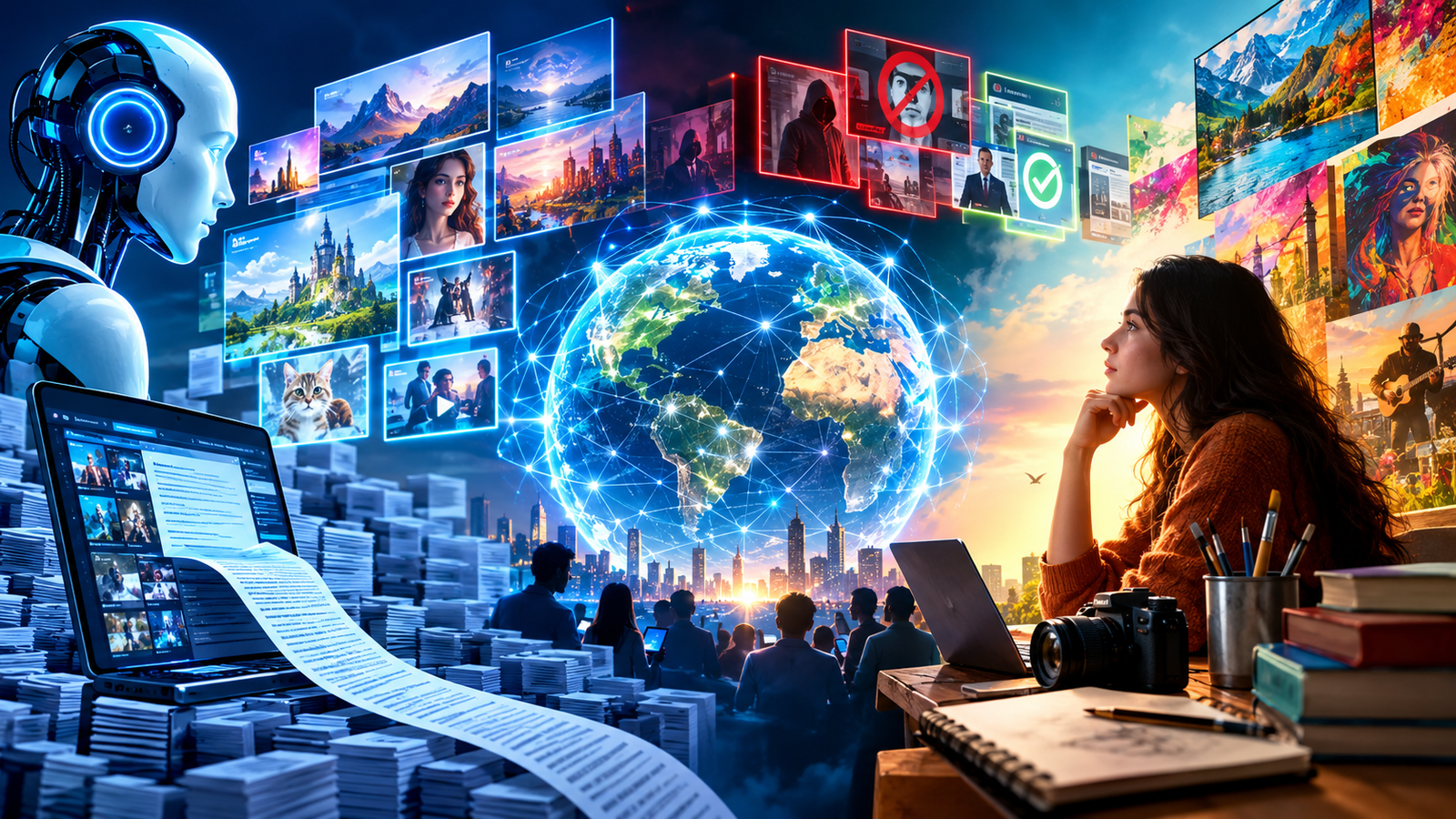
This transformation has created an important global question:
Will AI-generated content destroy the internet as we know it, or will it create a more intelligent, efficient, and creative digital future?
The answer is more complicated than a simple yes or no. AI-generated content is not automatically harmful. It can improve productivity, accessibility, education, creativity, and communication. However, the uncontrolled production of low-quality synthetic content creates serious challenges for trust, originality, information quality, journalism, scientific research, and human creativity.
Recent scientific studies and global technology discussions suggest that the internet is entering a major transition period. The central issue is no longer whether AI will produce content. It already does. The real question is whether humans, technology companies, search engines, governments, and creators can build systems that protect the value of authentic information.
1. AI-Generated Content Is Transforming the Internet
AI-generated content refers to text, images, videos, audio, code, and other digital materials created fully or partially using artificial intelligence systems.
Modern generative AI models can produce thousands of articles in minutes, create realistic photographs of nonexistent people, generate videos, imitate voices, write computer programs, and summarize complex information.
Before generative AI became widely available, creating high-quality digital content required significant time and human effort. Today, a single person using AI tools can operate a content production system capable of publishing hundreds of pages every day.
This has dramatically changed the economics of the internet.
The cost of producing digital content has fallen, while the volume of information has increased exponentially. The result is a digital environment where producing content is easier than ever—but determining whether content is valuable, accurate, original, or trustworthy is becoming increasingly difficult.
According to research published in 2026 by researchers examining the changing composition of the web, approximately 35% of newly published websites by mid-2025 were classified as AI-generated or AI-assisted. The study analyzed websites published between 2022 and 2025 using AI detection methods and Internet Archive data.
This does not mean 35% of the entire internet is AI-generated. Older human-created content still represents a significant portion of the web. However, the finding demonstrates how rapidly synthetic content is entering the digital ecosystem.
2. What Is AI Slop and Why Is It a Problem?
One of the most discussed consequences of generative AI is the rise of “AI slop.”
AI slop generally refers to large amounts of low-quality, repetitive, misleading, or meaningless content created primarily for clicks, advertising revenue, search rankings, or social media engagement.
Examples include:
- Automatically generated blog posts with little original information.
- AI-written product descriptions copied across thousands of websites.
- Fake social media accounts publishing synthetic images.
- Repetitive videos created to generate advertising revenue.
- AI-generated news articles without proper fact-checking.
- Fake reviews and fabricated testimonials.
- Low-quality academic papers containing incorrect references.
- Websites designed primarily to manipulate search engine rankings.
The problem is not simply that AI creates content. The problem is that the internet rewards attention, traffic, and volume.
When AI makes content production nearly free, bad incentives can encourage businesses and individuals to publish enormous quantities of material without investing in research, expertise, originality, or accuracy.
A 2026 study examining AI-generated text on the internet found evidence that increasing AI content correlates with reduced semantic diversity and more positive sentiment in online writing. Interestingly, the researchers did not find statistically significant evidence that AI-generated content necessarily reduces factual accuracy or stylistic diversity. This distinction is important because public fears and measurable evidence do not always match.
The scientific conclusion is not that AI slop is harmless. Instead, it shows that the effects of AI-generated content are complex and require careful measurement rather than assumptions.
3. The Biggest Threat: Loss of Trust in Online Information
Trust is the foundation of the internet.
People use search engines, news websites, social media platforms, educational resources, medical websites, scientific publications, and online communities because they believe the information has some connection to reality.
AI-generated content challenges this assumption.
Imagine reading an article about a historical event, a medical condition, a financial investment, or a scientific discovery. The article appears professional, includes statistics, contains citations, and uses confident language.
But what if the information was generated by AI without proper verification?
Large language models can produce convincing explanations while occasionally generating incorrect facts, invented references, or misleading conclusions. The writing may sound authoritative even when the underlying information is inaccurate.
This creates what researchers increasingly describe as a trust crisis.
A 2025 study examining determinants of trust in AI-generated content found that trust is influenced by factors including users’ experience with AI, awareness of how AI systems are developed, perceived technology design, and social influence. The study also highlighted concerns related to bias, inaccuracies, and the difficulty of understanding how AI systems generate information.
The challenge is particularly serious because humans are not always good at identifying AI-generated content.
Research published in 2023 found that participants often perceived AI-generated and human-generated content as having similar levels of credibility, competence, and trustworthiness. In some cases, AI-generated content was considered clearer and more engaging.
This creates an important paradox:
AI-generated content can appear trustworthy even when it has not been independently verified.
4. AI-Generated Content and the Future of Search Engines
Search engines have historically operated on a relatively simple model:
- Websites publish information.
- Search engines crawl and index the content.
- Algorithms rank pages based on relevance, quality, authority, and user experience.
- Users click on results and visit websites.
Generative AI changes this model.
Instead of searching through ten blue links, users increasingly ask AI systems direct questions and receive summarized answers.
This creates two major challenges.
Challenge One: Content Production Is Becoming Automated
If millions of websites publish AI-generated articles, search engines must determine which pages contain genuine value and which exist primarily to manipulate rankings.
Google has explicitly stated that using generative AI is not automatically against its policies. However, generating large amounts of content primarily to manipulate search rankings may violate its scaled content abuse policies.
Google’s guidance emphasises accuracy, quality, relevance, and adding value for users rather than simply producing automated pages.
This means website owners should understand an important distinction:
AI-assisted content can be acceptable, but mass-produced low-value content designed primarily for search manipulation is risky.
Challenge Two: AI Search May Reduce Website Traffic
Traditional search sends users to websites.
AI-powered search increasingly attempts to answer questions directly.
This creates concerns among publishers, journalists, bloggers, and independent website owners who depend on organic search traffic.
If users receive answers without clicking websites, the traditional content economy could change dramatically.
Google has publicly discussed its commitment to supporting publishers and creators while developing AI-powered search experiences. The company argues that AI should help users discover and engage with valuable content across the web.
However, the long-term economic consequences remain uncertain.
5. Scientific Research Shows AI Content Is Already Affecting the Knowledge Ecosystem
The impact of AI-generated content extends beyond blogs and social media.
Scientific publishing is also experiencing major changes.
Academic researchers increasingly use AI tools to write abstracts, summarize papers, generate research ideas, translate manuscripts, and assist with peer reviews.
These applications can be useful when applied responsibly. However, problems arise when AI-generated content contains fabricated citations, incorrect data, or poorly understood conclusions.
Research examining AI-generated content in peer reviews found a substantial increase in suspected AI-assisted writing after 2022. One 2026 study estimated that approximately 20% of ICLR reviews and 12% of Nature Communications reviews in 2025 were classified as AI-generated. The researchers emphasized that these findings are suggestive rather than definitive because AI detection methods have limitations.
Earlier research published in 2024 also estimated that between 6.5% and 16.9% of text submitted as peer reviews to several AI conferences may have been substantially modified by large language models.
These findings raise difficult questions:
- Who should be responsible for verifying AI-assisted scientific writing?
- Can peer review remain reliable if both papers and reviews are generated by AI?
- Will scientific knowledge become increasingly polluted by fabricated references?
- How can researchers distinguish genuine discoveries from automated text production?
The concern is not that AI will replace science.
The concern is that low-quality AI content could overwhelm the systems humans use to evaluate knowledge.
6. Human Creativity Is Not Automatically Being Destroyed
One of the strongest fears surrounding AI-generated content is the disappearance of human creativity.
Writers, artists, photographers, musicians, designers, journalists, and filmmakers worry that AI systems can imitate their work and produce content faster and cheaper.
These concerns are legitimate, particularly regarding copyright, compensation, artistic identity, and professional opportunities.
However, creativity is more than producing technically impressive output.
Human creativity includes:
- Personal experience.
- Emotional understanding.
- Cultural identity.
- Original observation.
- Moral judgment.
- Curiosity.
- Imagination.
- Intentional communication.
AI systems can generate patterns based on existing training data, but human creativity often emerges from lived experience and the desire to communicate something meaningful.
A machine can generate a poem about grief. A human being can write about losing someone they loved.
A machine can create an image of a mountain. A human photographer can spend years climbing mountains to capture a moment connected to memory, culture, and personal experience.
The distinction may become increasingly important in the future.
AI may become better at producing content.
Humans may become more valuable for deciding what content deserves to exist.
7. The Rise of Synthetic Media and Deepfakes
Text is only one part of the AI-generated content revolution.
Synthetic media includes AI-generated images, videos, voices, and digital personalities.
These technologies create enormous opportunities for entertainment, education, filmmaking, accessibility, and creative industries.
However, they also create serious risks.
Deepfake technology can be used to imitate politicians, celebrities, journalists, business leaders, and ordinary individuals.
False videos can spread misinformation before fact-checkers have time to respond.
Recent global discussions have highlighted the growing problem of unauthorized AI-generated advertisements and manipulated media. Reports in 2026 described cases where influencers’ faces and identities were used in fake advertising campaigns without permission, creating reputational and financial harm.
The challenge is that visual evidence has historically been powerful.
People often believe what they see.
AI challenges this assumption.
In the future, seeing may no longer be enough.
People may need to verify who created an image, where it originated, whether it has been digitally altered, and whether independent evidence supports its authenticity.
This represents a fundamental change in digital literacy.
8. AI Content Could Create an Internet Full of Machines Talking to Machines
One of the most interesting and concerning possibilities is the development of a self-reinforcing AI content ecosystem.
Consider this hypothetical cycle:
- Humans create original information.
- AI systems learn from human-created content.
- AI generates new content.
- Search engines index AI-generated content.
- Future AI models train on both human and AI-generated information.
- New AI systems produce content based increasingly on synthetic material.
Over time, the internet could contain an increasing amount of information generated indirectly from previous AI outputs.
This raises concerns about what researchers sometimes call model collapse or synthetic data contamination.
If future AI systems rely heavily on AI-generated training material, they may gradually lose exposure to original human perspectives, unusual ideas, cultural diversity, and authentic experiences.
The result could be a more repetitive digital environment.
This does not mean AI-generated content will literally destroy the internet.
But it could change the character of the internet.
The original vision of the web was a decentralized network of human communication.
The future internet may become a hybrid ecosystem where humans and machines continuously create, summarize, remix, evaluate, and distribute information.
9. Why AI-Generated Content Is Not Entirely Negative
Despite the concerns, AI-generated content offers enormous benefits.
Accessibility
AI can translate information into multiple languages, simplify complex topics, generate captions, and assist people with disabilities.
Education
Students can receive personalized explanations, practice exercises, and interactive learning support.
Small Businesses
Small companies can create marketing materials, product descriptions, websites, and customer support systems without large budgets.
Scientific Research
AI can assist researchers in analyzing large datasets, identifying patterns, and exploring hypotheses.
Creativity
Artists and creators can use AI as a brainstorming partner, editing assistant, design tool, or production accelerator.
Information Discovery
AI-powered systems can help users summarize complex topics and discover relevant information more efficiently.
The important distinction is between AI replacing human judgment and AI supporting human judgment.
The most productive future may involve collaboration rather than complete replacement.
10. Global Technology and Regulatory Discussions Are Increasing
Governments, technology companies, researchers, and international organizations are increasingly discussing how to manage AI risks.
The global debate focuses on several major areas:
- AI-generated misinformation.
- Deepfake regulation.
- Copyright and intellectual property.
- Transparency and disclosure.
- Scientific integrity.
- Platform accountability.
- AI safety standards.
- Human oversight.
- International cooperation.
The United Nations has emphasized the importance of international cooperation in AI governance. In 2026, UN officials called for global collaboration to prevent a race toward weaker AI safety standards.
Technology companies are also developing content provenance and watermarking technologies.
For example, researchers and technology organizations are exploring systems that can identify AI-generated media and provide information about how content was created.
However, watermarking alone will not solve the problem.
Detection technologies can fail, metadata can be removed, and AI systems continue to evolve.
The future will likely require multiple layers of protection, including:
- Human editorial review.
- Reliable citations.
- Content provenance standards.
- Transparent AI disclosure.
- Independent fact-checking.
- Platform moderation.
- Media literacy education.
- Stronger accountability systems.
11. What Website Owners and Content Creators Should Do
The rise of AI-generated content creates both opportunities and responsibilities for digital publishers.
Website owners should not focus exclusively on producing more content.
Instead, they should focus on producing better content.
A sustainable content strategy should include:
Original Research
Publish information based on genuine research, interviews, experiments, surveys, and expert analysis.
Human Experience
Add personal insights, case studies, observations, and unique perspectives that generic AI content cannot easily reproduce.
Accuracy
Verify statistics, references, scientific claims, and important information before publication.
Transparency
If AI tools were used significantly in content creation, consider providing appropriate context about how the content was produced.
Expertise
Demonstrate knowledge, experience, and credibility in the subject being discussed.
Quality Over Quantity
Publishing ten valuable articles is often more sustainable than publishing one hundred low-value pages.
Google’s guidance consistently emphasizes helpful, accurate, relevant content created for people rather than content created primarily to manipulate search rankings.
12. The Future of Content Will Be Defined by Trust
The internet is entering a new era where content creation is no longer the primary challenge.
The challenge is information quality.
In the past, publishing required resources. Today, publishing requires only a computer, internet access, and an AI tool.
This creates an information abundance problem.
When everything becomes easy to create, attention becomes scarce.
The most valuable content may no longer be the content that is cheapest or fastest to produce.
Instead, people may increasingly value:
- Verified information.
- Authentic human perspectives.
- Original research.
- Trusted experts.
- Transparent sources.
- Community reputation.
- First-hand experience.
- Demonstrated expertise.
This could create a new digital economy built around trust.
Websites and creators that establish credibility may become more important as the internet becomes increasingly saturated with synthetic content.
In other words, AI may unintentionally increase the value of human authenticity.
Conclusion: Will AI-Generated Content Destroy the Internet?
AI-generated content is unlikely to destroy the internet in a literal sense.
However, it is already changing the internet’s structure, economics, culture, and relationship with truth.
The greatest danger is not artificial intelligence itself.
The greater danger is the uncontrolled production of low-quality content combined with weak verification systems, financial incentives for misinformation, and declining human attention.
Scientific research shows that AI-generated content is rapidly increasing across websites and digital platforms. Studies have identified concerns about reduced semantic diversity, trust, peer-review integrity, and information authenticity. At the same time, research also demonstrates that some public fears about AI content are not yet supported by conclusive evidence.
This distinction matters.
The future should not be shaped by fear alone.
AI has the potential to improve human creativity, expand access to information, and accelerate scientific and technological progress. But these benefits depend on responsible development and human oversight.
The internet will likely survive AI.
The real question is whether it will remain a place where authentic human knowledge, creativity, and meaningful communication can thrive.
The future of the internet will not be determined only by how powerful AI becomes.
It will be determined by how wisely humans choose to use it.