
AI and Humanity in 2026: Understanding How Artificial Intelligence Is Reshaping Human Life.
Artificial intelligence has moved from being a specialised technology to becoming part of everyday human life. In 2026, AI can write software, generate images and video, support scientific research, summarize information, analyze data, tutor students, assist professionals and increasingly perform multi-step tasks through AI agents.
But the biggest question is no longer simply “What can AI do?”
The more important question is: “What happens to humanity as AI becomes increasingly capable?”
The answer is not predetermined. Artificial intelligence can expand human capabilities, improve productivity and accelerate scientific discovery, while also creating serious challenges involving employment, misinformation, privacy, cybersecurity, inequality, environmental impact and human control.
The 2026 Stanford AI Index describes a widening gap between rapidly advancing AI capabilities and society’s ability to evaluate, govern, and manage them.
The relationship between AI and humanity in 2026 is therefore not simply a story about machines replacing people. It is a much larger transformation in how humans work, learn, communicate, make decisions and create knowledge.
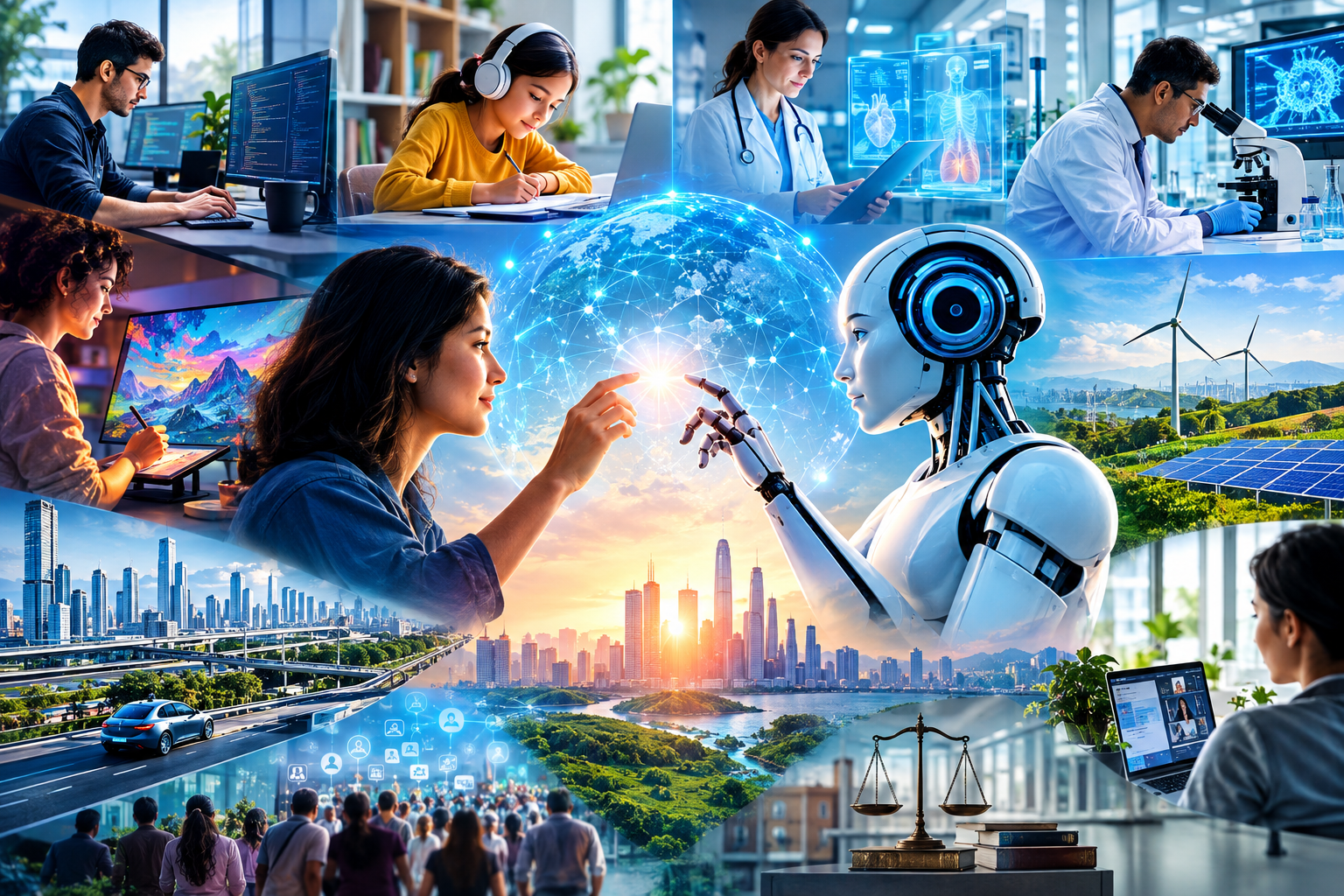
What Is Happening With AI in 2026?
AI capability is advancing extremely quickly.
Stanford’s 2026 AI Index reports that industry produced more than 90% of notable frontier AI models in 2025. It also reports that organisational AI adoption reached 88%, while four out of five university students use generative AI.
At the same time, AI performance remains uneven.
This is sometimes described as the “jagged frontier” of AI. A system may perform extremely well on advanced mathematics or programming benchmarks while failing at a seemingly simple real-world task. Stanford reports, for example, that a leading model achieved gold-medal-level mathematical performance while the same generation of systems could still struggle with basic visual reasoning tasks.
The International AI Safety Report 2026 reaches a similar conclusion: modern general-purpose AI systems are highly capable but remain unreliable in important ways, including hallucinations, inconsistent reasoning and failures in unfamiliar environments.
That distinction is critical.
AI capability is not the same thing as human-like intelligence, reliability or understanding.
10 Major Ways AI Is Changing Humanity in 2026
| Area | How AI Is Changing Humanity in 2026 — Opportunities & Concerns |
|---|---|
| Work | Change: Automation and AI-assisted tasks. Opportunity: Higher productivity and new forms of work. Concern: Job disruption and changing skill requirements. |
| Education | Change: Personalized, AI-assisted learning. Opportunity: Wider access to tutoring and educational support. Concern: Overdependence on AI and reduced independent learning. |
| Healthcare | Change: AI-assisted diagnosis, treatment research, and medical analysis. Opportunity: Faster research and potential improvements in healthcare delivery. Concern: Errors, bias, privacy, and accountability. |
| Search | Change: Conversational AI is transforming how people discover and summarize information. Opportunity: Faster research and direct answers. Concern: Reduced visibility and traffic for publishers and websites. |
| Creativity | Change: AI-generated text, images, audio, video, and other creative content. Opportunity: New creative tools and broader access to production. Concern: Copyright, originality, attribution, and authenticity. |
| Software | Change: AI coding assistants and autonomous software agents. Opportunity: Faster development and automation. Concern: Security vulnerabilities, bugs, and reliability issues. |
| Science | Change: AI-assisted research, analysis, and experimentation. Opportunity: Faster discovery and experimentation. Concern: Results still require rigorous human verification and reproducibility. |
| Society | Change: AI is reshaping communication, information access, and digital interaction. Opportunity: Greater accessibility and communication support. Concern: Misinformation, manipulation, and declining trust. |
| Environment | Change: Growing AI infrastructure alongside AI-based optimization of energy and resources. Opportunity: Better forecasting, optimization, and environmental monitoring. Concern: Rising electricity, water, and infrastructure demand. |
| Governance | Change: Governments and institutions are developing AI regulation, standards, and safety systems. Opportunity: Greater accountability and responsible AI oversight. Concern: Regulation and governance may develop more slowly than AI capabilities. |
1. AI Is Changing Human Work
One of the most visible effects of artificial intelligence is the transformation of work.
AI does not affect every occupation in the same way. Some tasks can be automated, others can be accelerated, and entirely new roles can emerge.
The World Economic Forum’s Future of Jobs Report 2025 projected that structural changes could create 170 million jobs and displace 92 million jobs by 2030, resulting in a projected net increase of 78 million jobs. The report also identified technological and human skills—including cognitive abilities and collaboration—as increasingly important.
This suggests that the future of work should not be described simply as:
“AI takes all the jobs.”
A more scientifically defensible description is:
AI changes the tasks that make up jobs.
Writing, research, programming, customer support, marketing analysis, translation, design and administration can increasingly involve AI assistance.
The competitive advantage may therefore move toward people who can combine:
human judgment + domain expertise + AI tools + communication + creativity.
Microsoft’s 2026 Work Trend Index similarly examines how AI agents and human agency are changing organisational work.
2. AI Is Changing Education
AI is also transforming how people learn.
A student can now ask an AI system to explain mathematics at different difficulty levels, practice another language, summarize a scientific concept or receive feedback on a draft.
This creates an opportunity for more personalized learning.
However, education faces an important challenge: learning is not identical to obtaining an answer.
If students outsource thinking completely, they may become dependent on systems that can themselves produce incorrect information.
The International AI Safety Report notes that current AI systems can still generate false information and behave inconsistently.
The educational goal should therefore move from simply teaching people how to obtain information toward teaching them how to:
- ask better questions;
- verify information;
- reason independently;
- understand evidence;
- recognize AI limitations;
- use AI as a learning assistant rather than a substitute for learning.
3. AI Is Accelerating Science and Medicine
Artificial intelligence is increasingly being used to assist scientific research.
AI systems can help researchers analyze large datasets, generate hypotheses, write code, summarize literature and explore complex scientific problems.
The 2026 Stanford AI Index includes dedicated chapters on science and medicine, reflecting how AI is expanding beyond consumer chatbots into scientific and clinical applications.
However, AI-generated scientific output still requires human validation.
A model can produce an impressive hypothesis without that hypothesis being experimentally correct.
This leads to a fundamental principle for AI-assisted science:
AI can accelerate the scientific process, but experiments and evidence remain essential.
4. AI Is Changing Google Search and the Internet
The traditional search experience is also changing.
Google has introduced AI Overviews and AI Mode, enabling people to ask longer, more complex and conversational questions.
Google reported that AI Overviews had expanded to more than 200 countries and territories and more than 40 languages by May 2025.
Google’s documentation also says AI Overviews and AI Mode can use “query fan-out,” where multiple related searches are performed across subtopics to construct a response with supporting links.
This creates a major change for websites and SEO.
SEO is no longer only about ranking for a short keyword.
Content increasingly needs to be:
- useful;
- original;
- factually supported;
- structured;
- comprehensive;
- easy for humans and search systems to understand;
- supported by authoritative sources.
Google explicitly states that existing SEO fundamentals remain relevant to AI search and emphasises helpful, reliable, people-first content.
For publishers, this means AI search optimisation should complement—not replace—traditional technical SEO.
5. AI Is Expanding Human Creativity
Generative AI can produce text, images, audio, video, software and other forms of content.
This changes the economics of creativity.
A person who previously needed several specialized tools may now be able to move from an idea to a prototype using natural language.
But AI-generated creativity raises difficult questions about:
- originality;
- copyright;
- attribution;
- artistic identity;
- misinformation;
- deepfakes;
- human authorship.
The important distinction is that AI can generate content, but human beings remain responsible for deciding what should be created, why it should exist and whether it is trustworthy.
6. AI Agents Are Changing Human-Computer Interaction
A major development in 2026 is the movement from conversational AI toward AI agents.
Traditional software generally waits for a human instruction and performs a defined operation.
An agent can potentially interpret a goal, plan multiple steps, use tools and execute actions.
That creates enormous productivity opportunities.
It also creates new safety problems.
The International AI Safety Report 2026 specifically identifies reliability and control challenges associated with increasingly capable AI systems and agents.
The more independently a system can act, the more important it becomes to define:
What is the AI allowed to do?
What requires human approval?
What happens when the AI makes a mistake?
Human oversight therefore becomes more—not less—important as AI becomes more autonomous.
7. AI Creates Real Risks to Humanity
AI risks should be separated into different categories rather than treating “AI risk” as one single phenomenon.
Current and documented risks include:
- inaccurate AI-generated information;
- fraud and impersonation;
- deepfakes;
- privacy violations;
- cybersecurity threats;
- discriminatory outcomes;
- excessive dependence on automated systems;
- labor-market disruption;
- concentration of technological power.
The International AI Safety Report also discusses emerging risks involving malicious use, manipulation, cyberattacks, biological and chemical risks, operational failures and potential loss of control.
At the frontier, some researchers are also studying the possibility that increasingly autonomous systems could become difficult to control.
However, the probability and timing of extreme outcomes remain highly uncertain.
That distinction matters.
A scientifically responsible discussion of AI safety should distinguish documented harms from possible future scenarios.
8. AI and the Environment
AI requires physical infrastructure.
Large-scale AI models run in data centres containing specialised processors, cooling systems, networking equipment and electricity infrastructure.
The International Energy Agency estimates that global data-centre electricity consumption could reach approximately 945 TWh by 2030 in its base case—more than double 2024 consumption. AI is identified as an important driver of this growth.
This does not mean AI alone will consume this entire amount. Data centers also support cloud computing, storage, networking and other digital services.
At the same time, AI can potentially help optimize electricity systems, industrial processes, transportation and energy infrastructure.
Therefore, the environmental question is not simply:
“Is AI bad for the environment?”
It is:
“Can the benefits created by AI justify and sustainably manage the resources required to operate it?”
9. AI Ethics Is Becoming a Human Issue
AI ethics is no longer an abstract technology debate.
AI can influence decisions involving employment, education, finance, healthcare, security and access to information.
UNESCO’s Recommendation on the Ethics of Artificial Intelligence places human rights and human dignity at the centre of responsible AI development. Its principles include transparency, accountability, human oversight, sustainability, privacy, fairness and non-discrimination.
This provides an important framework:
AI should serve human purposes rather than define human values by itself.
Technology can optimise a goal.
Humans must still decide whether the goal is legitimate.
10. The Future of Humanity May Depend on Human-AI Collaboration
The most important question may not be whether humans or AI will “win.”
That framing is too simplistic.
A more useful question is:
How can humans build systems in which AI capabilities increase human potential while human judgment remains meaningful?
This requires several forms of human capability:
- Critical thinking — questioning AI outputs rather than automatically trusting them.
- AI literacy — understanding what AI can and cannot do.
- Creativity — generating original goals and ideas.
- Emotional intelligence — understanding people and relationships.
- Ethical reasoning — deciding what should and should not be automated.
- Domain expertise — knowing when an AI answer makes sense.
- Communication — translating AI-generated information into human decisions.
- Accountability — accepting responsibility for consequential decisions.
The International AI Safety Report emphasises that current systems remain imperfect despite rapid capability improvements.
That means humans still have an essential role.
What Can Humans Still Do Better Than AI?
AI is increasingly powerful, but human intelligence has characteristics that cannot be reduced to benchmark scores.
Humans create values, relationships, cultures and purposes.
A language model can generate a poem about love. It does not follow from that capability that the system experiences love in the human sense.
A model can describe grief without necessarily experiencing grief.
A system can recommend a business strategy without having human responsibility for the consequences.
This distinction between simulation and experience is fundamental.
The future may therefore involve increasingly sophisticated AI systems working alongside humans rather than a simple replacement of humanity.
What Does AI Mean for the Future of Humanity?
There is no scientifically established single outcome.
Several futures remain possible.
AI could become an extremely powerful productivity technology that helps humans solve scientific and social problems.
It could also create significant disruption through automation, misinformation, inequality, cyberattacks and environmental pressures.
More advanced systems could introduce additional safety challenges.
The 2026 International AI Safety Report stresses that future AI development contains substantial uncertainty and that today’s decisions by developers, governments, researchers and communities can influence the trajectory of the technology.
This means the future of AI is not purely a technological question.
It is also a question of human institutions, education, economics, ethics and collective responsibility.
AI and Humanity in 2026: The Bigger Picture
Artificial intelligence is already changing human life.
It is changing how people search for information, write software, study, conduct research, create media and perform professional tasks.
But the defining feature of 2026 is not simply that AI has become more powerful.
It is that AI is becoming deeply integrated into human systems.
Stanford’s 2026 AI Index reports rapid capability gains, widespread adoption and growing economic impact, while also identifying a gap between AI progress and responsible-AI measurement.
Google’s evolution of Search demonstrates how AI is changing information discovery.
The IEA’s energy analysis demonstrates that AI’s digital growth has physical infrastructure consequences.
UNESCO’s ethics framework demonstrates why human rights, transparency, fairness and oversight must remain part of the conversation.
The evidence therefore points toward a balanced conclusion:
AI is neither simply humanity’s savior nor humanity’s inevitable destroyer. It is a powerful general-purpose technology whose consequences depend heavily on how humans develop, deploy, govern and use it.
The central challenge for 2026 and beyond is not merely building more intelligent machines.
It is building a society capable of using increasingly intelligent machines without losing human judgment, responsibility, creativity and dignity.